
Types Of Faux Leather: Vinyl, PU, Vegan And Bio-Based Leather Alternatives Explained
Faux leather is not one material. The term can describe vinyl, polyurethane-coated fabric, microfiber, silicone, bonded leather, plant-filled composites, mycelium sheets, and several newer technical materials that look similar but perform very differently.
This is why two sofas labeled “faux leather” can age in completely different ways. One may remain stable for years in a restaurant or boat, while another may begin peeling after repeated exposure to humidity, body heat, skin oils, or cleaning products. The appearance alone rarely tells the full story.
The most important questions are not simply whether a material is real or synthetic. Buyers should ask:
What is the surface made from?
What is the backing material?
Is the coating PVC, PU, silicone, TPU, or a hybrid?
Was the material designed for furniture, vehicles, marine use, healthcare, or fashion?
Can it be repaired if the surface fails?
Does “plant-based” describe the whole material or only one ingredient?
This guide explains the main types of faux leather, how they are constructed, where they work well, how they differ from genuine leather, and which marketing terms deserve closer examination.
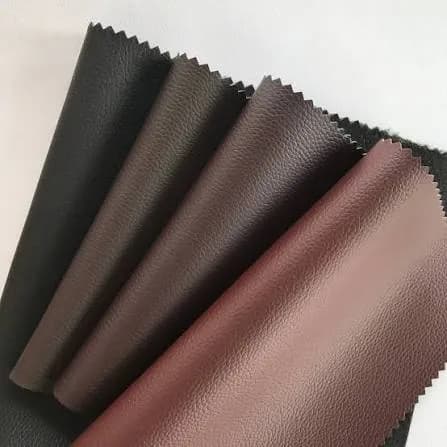
What Is Faux Leather?
Faux leather is a broad name for a material manufactured to resemble animal leather. Other common names include synthetic leather, artificial leather, leatherette, pleather, vegan leather, eco-leather, and imitation leather.
These names are not interchangeable chemical definitions.
| Marketing term | What it actually tells you |
|---|---|
| Faux leather, artificial leather, or leatherette | The material resembles leather but does not identify its composition |
| Eco-leather | Usually PU-coated textile, but the term has no reliable universal technical meaning |
| Vegan leather | The product is represented as animal-free; it may still be almost entirely plastic |
| PU leather | The surface contains polyurethane, but the backing and underlying layers may vary |
| Vinyl leather | A textile coated primarily with PVC |
| Bio-based leather alternative | Some raw material comes from biological sources; this does not automatically mean biodegradable |
| Recycled leather | May describe bonded leather made with leather fibers or a synthetic material with a recycled textile backing |
| Water-based PU | Water was used as a processing carrier; the finished coating is still polyurethane |
| PVC-free | The product does not use PVC, but it may contain PU, TPU, silicone, polyester, or another polymer |
The U.S. Federal Trade Commission states that a material resembling leather should disclose when it is not leather. The FTC also distinguishes solid animal hide from ground, pulverized, shredded, reconstituted, or bonded leather. If a product is promoted as bonded leather, the percentage of leather fibers and non-leather substances should be disclosed.
How Synthetic Leather Is Constructed
Most synthetic leather is a layered composite rather than one solid material. Its performance depends on every layer, not only the visible surface.
A typical construction may include:
Backing: woven polyester, cotton, knitted fabric, nylon, paper, microfiber, or split leather.
Intermediate layer: a solid or foamed polymer that creates thickness, softness, and flexibility.
Decorative face: PVC, PU, silicone, TPU, TPE, or another elastomer.
Protective topcoat: a thin finish controlling sheen, stain resistance, abrasion, and surface feel.
Embossed grain: a mechanically repeated pattern designed to imitate cowhide, pebble grain, reptile skin, or another texture.
This layered construction explains why the label “PU leather” is not enough to judge quality. A very thin PU topcoat can even be applied over a predominantly PVC construction. A buyer must know the full composition, backing type, resin chemistry, coating adhesion, and performance test results.
1. Vinyl Leather: PVC-Coated Fabric
Vinyl upholstery is usually made by applying flexible polyvinyl chloride, or PVC, to a woven or knitted textile backing. Plasticizers make the normally rigid PVC flexible. Additional topcoats and additives can improve resistance to ultraviolet light, mildew, stains, abrasion, cold, and cleaning chemicals.
Advantages of Vinyl
Vinyl offers several practical advantages beyond price:
Excellent surface water resistance
Easy cleaning
Resistance to many stains and chemicals
No polyurethane hydrolysis
Consistent color, thickness, and grain
Large usable rolls with little cutting waste
Heat- and radio-frequency-weldable seams
Specialized marine, healthcare, automotive, and outdoor grades
Good abrasion resistance when correctly specified
These characteristics make vinyl useful where moisture protection and sanitation matter more than natural feel or breathability.
Disadvantages Compared With Leather
Minimal moisture absorption and limited breathability
Can feel hot, sticky, or less comfortable against bare skin
May harden or crack as plasticizers migrate or are lost
Lower-quality grades can become brittle in cold conditions
Does not develop a natural patina
Cannot be restored with leather conditioners
Difficult to recycle because of its multilayer construction
Broad aging or plasticizer loss cannot be reversed by a cosmetic coating
Best Uses for Vinyl
Purpose-engineered vinyl works well for restaurant booths, medical seating, gym pads, motorcycles, golf carts, commercial chairs, and outdoor furniture. Marine-grade vinyl remains one of the most practical materials for boat seats because it is designed around water resistance, UV exposure, salt, mildew, and repeated cleaning. Ordinary residential vinyl should not be substituted for professional marine upholstery, because visually similar products may have very different weathering properties.
2. PU Leather: Polyurethane-Coated Textile
PU leather usually consists of a textile backing covered with one or more polyurethane layers. It is generally softer, lighter, and more flexible than vinyl and can reproduce a finer, more natural-looking grain.
However, polyurethane is not one universal resin. Its chemistry significantly affects its resistance to heat and moisture.
Polyester-Based PU
Polyester-based polyurethane is usually the least expensive and the most vulnerable to hydrolysis. Prolonged humidity, heat, body warmth, perspiration, and unsuitable cleaning products can break down the polymer. The surface may crack, flake, become sticky, or separate from the backing.
Polyether-Based PU
Polyether PU generally provides better resistance to heat and humidity. It may be appropriate for better-quality residential and contract upholstery, depending on the complete construction and test results.
Polycarbonate-Based PU
Polycarbonate PU normally offers the best hydrolysis resistance in the PU family and is commonly selected for demanding contract, hospitality, healthcare, and transportation applications. It also costs more than ordinary polyester PU.
The Association for Contract Textiles recommends evaluating PU-coated upholstery through ISO 1419 hydrolysis testing. ACT recommends a minimum five-week result for general indoor contract upholstery, while emphasizing that laboratory weeks should not be marketed as a direct number of service years.
Advantages of PU Leather
Softer and lighter than many vinyls
Better drape and a more natural fold
Fine embossed textures and a wide range of finishes
Greater design freedom in color, gloss, metallic effects, and surface feel
Potentially better water-vapor transmission than solid vinyl
Consistent roll size and thickness
Water-based and solvent-free manufacturing options
Lower cutting waste than irregular animal hides
Disadvantages Compared With Leather
Vulnerable to hydrolysis depending on resin chemistry
Sensitive to certain disinfectants, solvents, cosmetics, and body oils
Usually lower moisture absorption and thermal comfort
Often fails by peeling rather than developing patina
Cannot be conditioned back to health after polymer degradation begins
Widespread delamination is rarely repairable for the long term
Shelf age and storage conditions can affect the material before the furniture is even sold
Standard PU can be suitable for handbags, footwear, clothing, decorative furniture panels, headboards, and moderate-use seating. It should not be used automatically for boats, outdoor seating, healthcare furniture, vehicle interiors, or heavily used sofas unless the particular grade was designed and tested for that application.
3. Microfiber Synthetic Leather
Microfiber synthetic leather is one of the closest engineered alternatives to the internal structure of genuine leather. Instead of relying on an ordinary woven or knitted backing, it uses extremely fine polyester or nylon fibers arranged in a dense three-dimensional nonwoven network. The network is impregnated with polyurethane and may receive an additional smooth PU surface.
This construction is stronger and more stable than basic PU applied to inexpensive fabric.
Advantages of Microfiber Leather
Better tear resistance than ordinary PU-coated fabric
Improved seam strength
More stable dimensions
Soft, leather-like hand
Lower weight
Better resistance to stretching around corners and curves
Some grades offer improved water-vapor transmission
Suitable for footwear, automotive interiors, handbags, sports products, and furniture
Limitations
Still primarily a synthetic composite
Quality varies substantially between suppliers
A smooth PU face can still peel if the chemistry or adhesion fails
Less moisture absorption than natural leather
Does not age into a true leather patina
Delaminated areas remain difficult to restore invisibly
For handbags, premium microfiber is generally a much better choice than a thin PU film on a weak knitted backing. Handles and shoulder straps should still be reinforced internally with webbing, cord, or another load-bearing component.
4. Artificial Suede: Alcantara, Ultrasuede and Similar Materials
Artificial suede is a microfiber material with an open, velvety surface rather than a smooth leather-like film. Alcantara is a registered brand, not a generic name; its manufacturer identifies its standard composition as approximately 68% polyester and 32% polyurethane.
High-quality artificial suede can be lightweight, breathable, warm to the touch, resistant to fraying, and easy to shape around complex interior components. It is widely used for automotive headliners, seat inserts, dashboards, steering wheels, furniture, footwear, and fashion accessories.
Its limitations are different from those of smooth PU:
Skin oils can darken the fibers.
Friction can flatten or polish the nap.
Inappropriate cleaning can leave rings or stiffness.
Recoloring may harden the texture.
Worn fibers cannot simply be recreated with paint.
Generic microfiber should not be assumed to meet automotive, marine, or aviation requirements.
5. Silicone-Coated Upholstery
Silicone upholstery uses a silicone elastomer face on a textile backing. It is not subject to classic PU hydrolysis and does not require the plasticizers used to make flexible PVC.
Advantages of Silicone Upholstery
Excellent resistance to humidity and heat
Strong UV and cold-weather performance in suitable grades
High resistance to stains, ink, and denim dye transfer
Compatibility with many healthcare cleaning products
Soft, dry surface feel
Low-VOC solvent-free manufacturing options
No PVC or conventional PU in true silicone-face products
Useful for healthcare, hospitality, marine, outdoor, and high-traffic seating
Limitations
Higher material cost
Low surface energy makes conventional adhesives, paints, and repair coatings difficult to use
Cuts and abrasions can be challenging to restore
Smaller range of suppliers and decorative effects than PU or PVC
Not biodegradable merely because silicon is derived from mineral feedstocks
Requires application-specific sewing, bonding, and finishing methods
Silicone can outperform leather in environments that demand repeated disinfection, water resistance, and exposure to heat or sunlight. It is not necessarily the best material for a traditional handbag or a surface that may later require refinishing.
6. TPU, TPE and TPO Leather Alternatives
Thermoplastic Polyurethane
TPU can be softened with heat, extruded, welded, and formed. It offers strong abrasion resistance, elasticity, resistance to oils, and the ability to create thin, lightweight surfaces. It is increasingly used in automotive interiors, footwear, sports products, bags, and technical upholstery.
TPU may be mechanically recyclable in controlled systems, but real recyclability depends on the complete product. A TPU face permanently laminated to polyester, foam, adhesive, and another backing is no longer a simple mono-material.
TPE and TPO
Thermoplastic elastomers and polyolefin surfaces are especially common in molded automotive trim and newer fused commercial textiles. They can be lightweight, PVC-free, low in VOCs, water resistant, and compatible with thermoforming.
Their limitations include a less natural hand, difficult paint and adhesive bonding, specialized repair requirements, and fewer traditional leather textures. They are often better suited to vehicle panels and technical components than classic furniture or handbags.
Automotive names such as MB-Tex, Sensatec, SofTex, V-Tex, Veganza, and Nordico are proprietary product systems, not separate scientific material categories. Their composition and repair behavior can also change by manufacturer, model, and year. For this reason, professional car upholstery repair begins with identifying the actual seat covering rather than relying on the sales name.
7. Bonded, Reconstituted and Recycled Leather
Bonded leather is produced by grinding leather scraps into short fibers, combining them with polyurethane, latex, or another binder, forming a sheet on a textile or paper backing, and covering the surface with an embossed synthetic film.
It contains animal leather, but it is not an intact hide and it is not vegan.
Advantages
Uses some leather-production waste
Consistent thickness and appearance
Efficient roll cutting
Lower initial cost than grain leather
Can look convincing when new
Disadvantages
The original continuous collagen network has been destroyed
Strength often depends on the backing and binder
The face can peel in flakes
Body-contact areas frequently deteriorate first
Conditioner cannot rebuild a failing binder
Widespread peeling cannot be stopped reliably with color alone
Mixed leather, polymer, paper, and textile layers are difficult to recycle
One of the least durable choices for sofa seats, recliners, and other high-contact surfaces
Localized damage may sometimes be stabilized, but broad delamination is a material failure rather than a simple color problem. A professional Leather peeling repair assessment should determine whether the backing remains stable or whether panel replacement or complete reupholstery is more realistic.
8. Bicast Leather and PU-Coated Split Leather
Bicast leather is a hybrid material. Its backing is a continuous lower split of animal hide, while its visible surface is formed by a thick PU or PVC film. It is usually stronger than bonded leather because the split remains intact, but it behaves more like a coated material than premium grain leather.
Bicast leather offers a uniform appearance and easy cleaning, yet it has limited breathability, does not accept ordinary leather conditioner through the coating, and may eventually crack or peel. It does not develop the same patina as full-grain or top-grain leather. Once the face separates broadly from the split, restoration options become limited.
9. Plant-Based and Agricultural-Waste Leather Alternatives
The phrase “plant leather” can be misleading because many products are not solid sheets made entirely from a plant. More commonly, plant fibers, powders, oils, or agricultural waste are added to a polymer composite or used to form a backing that still requires a protective synthetic coating.
| Material family | Typical construction | Important limitation |
| Pineapple-leaf material | Pineapple fibers and PLA in a nonwoven base with a PU finish | Finished material is not completely biodegradable |
| Apple material | Apple-pomace particles in a PU-based coating on textile | Often behaves similarly to conventional PU |
| Grape material | Grape waste and plant oils incorporated into a polymer composite | Exact formulation varies by collection |
| Cactus material | Cactus-derived ingredients combined with proprietary bio-polymers and backing | Bio-based percentage and performance vary by grade |
| Corn-based PU | Polyurethane made partly with plant-derived polyols | Still polyurethane and not automatically biodegradable |
| Mango, banana, coffee, coconut, or orange materials | Fibers or particles combined with a binder | Many remain niche, composite, or experimental products |
| Leaf material | Preserved leaves laminated to textile and sealed | Limited seam, fold, water, and abrasion performance |
Piñatex provides a useful example of transparent composition. Its manufacturer states that the base contains 80% pineapple-leaf fiber and 20% PLA. Piñatex Original uses a PU coating representing approximately 10% of the finished material, while the Performance version uses a much larger high-solid and bio-based PU coating. The base may biodegrade under controlled industrial conditions, but the complete product is not 100% biodegradable.
Plant-based content can reduce dependence on fossil feedstocks and create useful demand for agricultural waste. However, it does not automatically provide the tear strength, flexibility, water resistance, seam performance, or long-term repairability of animal leather.
Plant composites can be suitable for wallets, light handbags, decorative panels, accessories, and selected footwear. They should not be used automatically for structural handles, seat bolsters, outdoor furniture, boat seats, healthcare upholstery, or other high-stress applications without complete test data.
10. Cork, Paper and Natural-Rubber Alternatives
Cork Leather
Cork textile is made by laminating a thin layer of cork onto cotton, polyester, or another backing. It is lightweight, visually distinctive, and useful for wallets, covers, decorative bags, footwear accents, and interior panels.
It can crack at tight folds, tear near stitching holes, or separate from its backing. Cork should not be treated as a load-bearing handbag strap unless the structure includes appropriate internal reinforcement.
Washable Paper
Washable kraft paper and products such as SnapPap use cellulose fibers with latex, acrylic, or another binder. They can work well for labels, baskets, wallets, covers, and lightly used bags. They are not direct replacements for upholstery leather in seating, vehicle interiors, wet footwear, or structural straps.
Natural-Rubber Composites
Materials such as MIRUM use combinations of natural rubber, plant oils and waxes, minerals, natural fillers, and pigments rather than conventional PU or PVC. These systems may reduce plastic content and offer useful flexibility, but natural rubber can still age through heat, oxygen, ozone, and UV exposure. Long-term seam strength, color stability, repair methods, backing construction, and application-specific performance must still be evaluated.
11. Mycelium and Bacterial-Cellulose Leather Alternatives
Mycelium Materials
Mycelium is the branching fiber network of fungi. It can be grown into sheets, compressed, dyed, reinforced, and finished to create a leather-like material.
The technology has several potential advantages: renewable feedstocks, controlled growth, distinctive texture, and the possibility of using agricultural waste. The challenge is achieving water resistance, flexibility, tear strength, surface consistency, and biodegradability at the same time. Polymer coatings and textile reinforcement may improve performance while reducing end-of-life advantages.
Mycelium materials remain promising for fashion and selected accessories, but commercial availability, formula stability, scale, and long-term service history vary considerably.
Bacterial Cellulose
Bacterial cellulose can be grown through fermentation into a dense sheet sometimes called kombucha leather. In its untreated form, it may be biodegradable and visually interesting. It also tends to react strongly to water, shrink during drying, become brittle, and require oils, waxes, plasticizers, or polymer treatments.
For now, bacterial cellulose is better suited to research, craft, fashion concepts, and decorative applications than high-wear furniture, vehicle seats, boat seating, structural bag components, or wet footwear.
Faux Leather vs. Real Leather: Performance Comparison
| Property | Genuine leather | Vinyl | Standard PU | Microfiber PU | Silicone | Plant-based composites |
| Overall durability | High when quality and care are appropriate | Moderate to high in specialized grades | Low to moderate, depending on chemistry | Moderate to high | High in suitable applications | Highly variable |
| Moisture comfort | Good, depending on finish | Low | Low to moderate | Moderate | Low to moderate | Variable |
| Surface water resistance | Moderate | Excellent | Good | Good | Excellent | Usually moderate |
| Resistance to frequent disinfection | Limited | Good in healthcare grades | Product-specific | Product-specific | Often excellent | Usually limited |
| Repairability | Best overall | Limited | Low after delamination | Limited | Low | Limited or unknown |
| Natural patina | Yes | No | No | Usually no | No | Sometimes visually interesting but unpredictable |
| Uniform color and grain | Naturally variable | Excellent | Excellent | Excellent | Excellent | Product-specific |
| Animal-free | No | Yes | Yes | Yes | Yes | Usually |
| Biodegradability | Depends on tanning and finish | No | No | No | No | Only certain formulas and conditions |
Why Genuine Leather Is Difficult to Replicate
Leather is not simply a surface film. Its collagen fibers form a continuous three-dimensional network. Near the grain, fibers are finer and more densely arranged. Deeper in the hide, they become larger and more open. This gradual change in density allows one material to combine tear strength, seam strength, flexibility, vapor absorption, vapor transmission, shape retention, and repairability.
Synthetic materials can outperform leather in a specific category. Silicone may tolerate disinfectants better. Marine vinyl may protect foam from water more effectively. Microfiber can provide exceptional dimensional consistency. TPU can be lighter and easier to thermoform.
The difficulty is reproducing the complete balance of properties in one material. Many substitutes perform very well in one or two categories but depend on a thin surface layer that eventually fails by cracking, hydrolysis, plasticizer loss, or delamination.
How to Tell Real Leather From Faux Leather
No single home test is completely reliable, especially when comparing high-quality microfiber with heavily finished corrected-grain leather. The most useful clues are the product specification, backing, and cut edge.
Examine the Cut Edge
Genuine leather shows a continuous, irregular fiber structure rather than separate fabric and coating layers.
Basic PU and vinyl show a visible face film over woven or knitted backing.
Microfiber has a dense, uniform, suede-like nonwoven core.
Bonded leather looks like a compressed layer of short particles or fibers.
Bicast leather shows a substantial synthetic film over a continuous fibrous leather split.
Plant-based composites often look similar to PU-coated textiles at the edge.
Inspect the Back
A visible weave, knit, or repeating textile grid usually indicates coated fabric. However, some genuine leather products have separate linings, and some synthetic materials conceal the backing.
Look for Repeating Grain
Mechanically embossed grain may repeat at regular intervals. This can indicate a synthetic surface, but corrected-grain leather and embossed split leather can also show repeated patterns.
Flex the Material
Natural leather often forms many small, irregular wrinkles. A coated film may create broader and more uniform folds. This is only a clue, not proof.
Avoid Destructive Tests
Smell, water drops, burning, solvents, and sharp-needle tests are unreliable or damaging. Artificial fragrance can imitate leather smell, protected leather can repel water, and burning PVC can produce hazardous smoke. Laboratory microscopy and spectroscopy provide more reliable identification.
Which Material Is Best for Each Application?
| Application | Better alternatives | Materials to approach cautiously |
| Residential sofa | Premium microfiber PU, tested polycarbonate PU, quality silicone | Bonded leather and untested polyester PU |
| Recliner and headrest | Genuine leather, silicone, contract-grade PU | Unspecified “eco-leather” |
| Restaurant booth | Contract vinyl, silicone, chemical-resistant PU | Ordinary residential PU |
| Healthcare seating | Medical-grade silicone, vinyl, or tested PU | Plant composites without cleaning data |
| Boat seating | Marine vinyl or marine-rated silicone | Standard PU, bonded leather, paper, and most plant sheets |
| Outdoor furniture | Outdoor silicone or UV-rated vinyl | Indoor furniture PU |
| Automotive seat | OEM automotive PU, TPU, TPO, vinyl, or microfiber | General furniture material |
| Handbag body | Premium microfiber PU, TPU, selected plant composites | Thin PU on weak knit backing |
| Handbag handle or strap | Reinforced microfiber PU or TPU | Bonded leather, paper, cork, or plant sheet without webbing |
| Footwear | Microfiber PU, TPU, or application-tested PU | Materials without flex and water testing |
| Aircraft interior | Documented aviation-grade materials | Residential or automotive material without applicable records |
Transportation and business environments require more than an attractive sample. Professional aircraft seat reupholstery must account for the aircraft’s approved configuration, material documentation, flammability requirements, weight, and coordination with responsible maintenance personnel. Likewise, commercial upholstery must consider traffic, cleanability, downtime, seam design, and the actual chemicals used by the facility.
Can Peeling Faux Leather Be Repaired?
The answer depends on whether the damage is local or systemic.
A small cut, puncture, scuff, open seam, or isolated coating loss may sometimes be reinforced, filled, color matched, and protected. The repair is more likely to remain stable when the surrounding material is still flexible and firmly bonded to its backing.
Widespread peeling is different. It usually means the polymer, binder, plasticizer system, or coating adhesion is failing across the material. Painting over the loose surface may improve appearance briefly, but it cannot rebuild a chemically degraded layer.
Signs that reupholstery may be more appropriate include:
Peeling across multiple panels
Cracking wherever the material flexes
Sticky or powdery surface deterioration
Brittle upholstery around seams
Delamination extending beyond the visible damage
Failed bonded leather across all contact areas
Repeated failure after earlier cosmetic repairs
The correct solution may be replacing one panel, partially reupholstering the item, or replacing the entire cover.
Repair, Restore, Reshape or Reupholster?
Surface material is only one part of upholstered furniture. The frame, suspension, foam, batting, seams, and covers should be evaluated separately.
Leather color restoration is appropriate when genuine leather remains structurally sound but its protected finish has faded, worn, or become uneven.
Cushion replacement is appropriate when foam has collapsed but the frame and upholstery remain serviceable.
Reshape work can rebuild cushion profiles, reduce damaging wrinkles, and improve support when the existing foam can be supplemented rather than completely replaced.
Reupholster is the better decision when the covering material is failing broadly but the frame remains worth preserving.
Leather reupholstery replaces structurally weak panels or the complete cover with properly selected upholstery leather.
Before discarding a structurally sound sofa, it is useful to ask: Why restore leather furniture instead of replacing? The answer may involve frame quality, comfort, sentimental value, fit, material quality, waste reduction, or the cost of buying genuinely comparable furniture.
Advantages of Leather Alternatives Beyond Price
High-quality synthetic materials are not simply cheap copies of leather. Depending on the application, they can provide meaningful advantages:
Consistent grain and color
Large roll size without scars or irregular hide edges
Reduced cutting waste
Predictable thickness
Easier automated cutting
Bright, metallic, white, and highly uniform colors
Strong surface water resistance
Compatibility with frequent cleaning and disinfection
Lower weight
Heat-weldable construction
Animal-free product options
Purpose-engineered resistance to UV, salt, cold, chemicals, or hydrolysis
Lower-VOC manufacturing in certain water-based, high-solid, or solvent-free systems
The correct question is therefore not whether synthetic material is always worse than leather. The better question is whether the chosen material solves the complete performance problem for its intended environment.
How Manufacturers Reduce Cost
Several shortcuts can make two visually similar faux leathers perform very differently:
Using the term “eco-leather” without identifying the polymer.
Marketing a product as vegan in a way that implies it is plant-based.
Emphasizing a small percentage of plant filler while minimizing the main plastic components.
Applying a PU topcoat over a predominantly PVC construction.
Using inexpensive polyester PU instead of polyether or polycarbonate PU.
Using a thin knitted backing that stretches and fails around seams.
Installing better material on visible panels and cheaper material on sides, backs, or areas between cushions.
Calling bonded leather a genuine leather blend without a clear fiber percentage.
Promoting recycled content when only the hidden backing is recycled.
Using a very high abrasion-cycle number as proof of service life.
Abrasion results alone do not predict hydrolysis, UV degradation, cleaner compatibility, coating adhesion, plasticizer loss, or failure from skin oils. A material can pass an impressive abrasion test and still peel prematurely for an entirely different reason.
What to Ask Before Buying Faux Leather or Upholstery Material
Request a complete technical data sheet and ask for:
Face polymer and percentage composition
Backing type and fiber content
Confirmation of whether PVC is present
PU resin family: polyester, polyether, or polycarbonate
ISO 1419 hydrolysis result for PU upholstery
Flex-cracking performance
Tensile and tear strength
Seam strength
Coating adhesion or peel strength
Abrasion results and test method
UV and lightfastness data
Cold-crack temperature
Cleaner and disinfectant compatibility
Recommended indoor, outdoor, marine, automotive, or healthcare use
Written warranty
Automotive flammability and aging documentation when applicable
Aviation documentation when applicable
Verified bio-based and recycled percentages
The test standard and conditions behind any biodegradability claim
A supplier offering only a trade name, a soft sample, and an abrasion number has not provided enough information for a high-value upholstery decision.
Frequently Asked Questions About Faux Leather
Is Eco-Leather the Same as PU Leather?
Often, but not always. Eco-leather is an inconsistent marketing term. Many sellers use it for PU-coated fabric, while others use it for PU/PVC hybrids, recycled composites, plant-filled materials, or bonded leather. Always request the exact composition.
Is Vegan Leather Made From Plants?
Not necessarily. Vegan leather may be PVC, PU, TPU, silicone, microfiber, or a plant-polymer composite. The term indicates the represented absence of animal material, not the percentage of plant content or environmental performance.
Which Is Better, PU or Vinyl?
PU is generally softer, lighter, and more leather-like. Vinyl is generally more water resistant and is not affected by PU hydrolysis. Premium polycarbonate PU can be an excellent furniture material, while marine vinyl is usually more appropriate for boat seating. The intended application determines which is better.
What Is the Most Durable Faux Leather?
There is no universal winner. Silicone, premium microfiber, polycarbonate PU, automotive TPU/TPO, and specialized vinyl can all be highly durable in the environment for which they were engineered. Generic residential PU and bonded leather are much less reliable in heavy-contact applications.
Why Does Faux Leather Peel?
Common causes include hydrolysis, binder degradation, poor coating adhesion, plasticizer loss, UV exposure, body oils, repeated flexing, excessive heat, incompatible cleaners, or a weak textile backing. Widespread peeling usually indicates material failure rather than ordinary color wear.
Can Faux Leather Be Conditioned?
Leather conditioner cannot replace plasticizers, rebuild degraded polyurethane, or rebond a separating coating. Faux leather should be cleaned and maintained only with products approved by its manufacturer.
Is Bonded Leather Real Leather?
It contains leather fibers, but it is not an intact hide. The fibers are ground, mixed with binders, formed into a sheet, and usually covered with an artificial surface. It performs very differently from full-grain, top-grain, or solid split leather.
Are Plant-Based Leather Alternatives Biodegradable?
Some plant or microbial components may biodegrade under defined conditions. The finished material may also contain PLA, PU, textile backing, pigments, adhesives, and protective coatings. A valid claim should identify which part biodegrades, under what test, and in what environment.
When Is Reupholstery Better Than Repair?
Reupholstery is usually more appropriate when peeling, brittleness, cracking, or delamination extends across multiple panels; when the material cannot support a stable repair; or when earlier cosmetic repairs continue to fail. A strong frame and support system may still make the furniture worth rebuilding.
Final Takeaway
The best leather alternative is not the material with the most appealing name. It is the material whose complete construction has been matched to the actual use.
Vinyl can outperform leather around water. Silicone can outperform it under repeated disinfection. Microfiber can provide exceptional consistency and tear resistance. TPU and TPO can reduce weight and support technical manufacturing. Plant-based and mycelium materials may reduce animal content or replace part of the fossil feedstock.
At the same time, genuine leather still provides an unusual combination of strength, flexibility, moisture regulation, aging character, and repairability that no single substitute reproduces in every category.
Before purchasing furniture, selecting upholstery, or attempting a repair, identify the material first. A correct diagnosis determines whether the right solution is cleaning, surface restoration, panel replacement, cushion work, or complete reupholstery.