
Tesla Seat Material Explained: Why Peeling Vegan Leather Often Needs Reupholstery
Tesla interiors are known for their minimalist design and leather-like seating surfaces, but the material used in modern Tesla seats is not traditional automotive leather.
Tesla uses synthetic upholstery commonly referred to as vegan leather. It is engineered to provide the appearance, texture, softness, and flexibility associated with leather without using animal hide.
This distinction becomes especially important when the seat is damaged.
A scratch, worn bolster, color loss, bubbling surface, peeling coating, or tear may look similar to damage found on genuine leather, but the repair options can be very different.
Some Tesla seat damage can be restored successfully. In other cases, particularly when the synthetic material itself begins separating or deteriorating, cosmetic restoration may provide only a temporary improvement.
For Tesla owners considering automotive upholstery repair in Austin, the first question should be whether the damage is limited to the surface finish or whether the upholstery material itself has begun to fail.
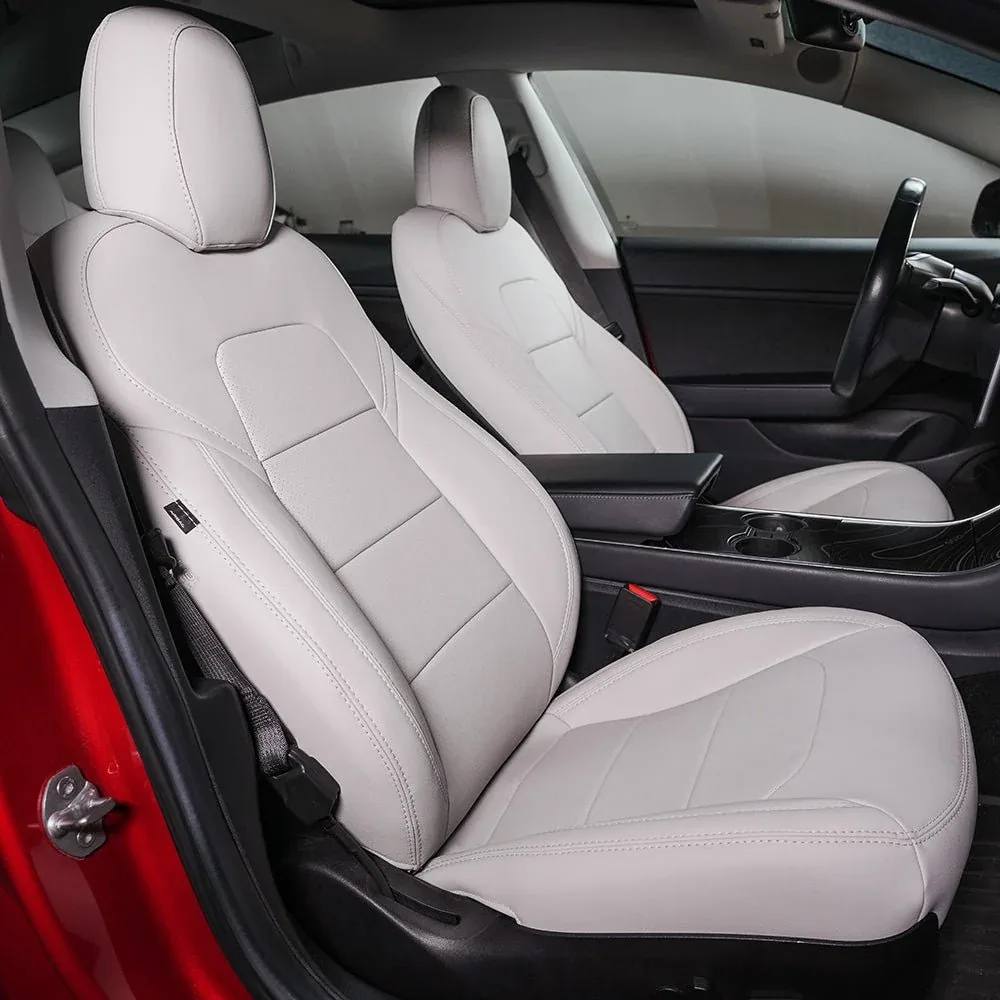
What Are Tesla Seats Made Of?
Modern Tesla vehicles generally use synthetic leather-like upholstery rather than traditional animal leather.
The material is commonly described as vegan leather.
The term can sometimes cause confusion because “vegan leather” does not necessarily mean that the upholstery is made from plants.
Synthetic automotive upholstery typically consists of a fabric or textile backing combined with engineered surface layers that create the grain, color, texture, flexibility, and protective finish.
The upper layer creates the leather-like appearance.
The lower layers provide strength and structure.
This construction works well for automotive interiors, but it also means that the material behaves differently from genuine leather when damaged.
Are Tesla Seats Made From Cactus Leather?
There is a common misconception that Tesla seats are made from cactus leather.
Plant-based leather alternatives made from cactus and other agricultural materials do exist, but Tesla upholstery should not automatically be described as cactus leather.
The term vegan leather simply means that animal hide is not being used.
It does not mean that the material is necessarily cactus-based, fully plant-based, or free from synthetic polymers.
For restoration purposes, the marketing terminology is less important than the actual condition of the upholstery.
A technician needs to determine whether the damage affects:
- the protective finish;
- the colored surface;
- the synthetic coating;
- the backing;
- the stitching or seams;
- or several layers at once.
That determines whether the seat can be restored or whether the damaged section should be replaced.
Why Tesla Vegan Leather Behaves Differently From Genuine Leather
Genuine leather is a natural fibrous material.
If the color or protective finish on automotive leather becomes scratched or worn, the hide underneath may still remain structurally strong.
In those cases, professional restoration can involve cleaning, preparation, minor filling, color restoration, and application of a new protective finish.
Synthetic upholstery is different.
Its visible surface is part of a manufactured layered material.
If only the upper finish is damaged, restoration may still be possible.
But once the synthetic coating begins separating from its backing, there may no longer be a stable surface to restore.
This is the most important difference.
You can restore lost color.
You can repair certain scratches.
You can correct some localized surface damage.
But applying another coating over material that is already delaminating does not permanently rebuild the failed upholstery underneath.
Our guide to repairing versus reupholstering damaged car seats explains this distinction in greater detail.
Why Do Tesla Seats Peel, Bubble, or Crack?
Several different forms of deterioration can produce similar-looking damage.
That is why the entire affected panel needs to be evaluated rather than looking only at the most visible spot.
Friction
The outer bolster on the driver's seat is one of the highest-wear areas in almost any vehicle.
Every time the driver enters or exits, clothing rubs against the upholstery.
Over time, this can create:
- surface wear;
- scratches;
- loss of texture;
- thinning of the coating;
- stretching;
- eventually deeper material damage.
Minor abrasion can sometimes be restored.
Once the material itself begins breaking down, replacement becomes more appropriate.
Repeated Flexing
Seat upholstery constantly moves.
The seat bottom stretches under body weight.
Bolsters compress.
The backrest changes shape.
Every repaired area must remain flexible enough to tolerate that movement.
A repair may look excellent immediately after refinishing but still fail later if the original material underneath has already become weak.
Heat
Automotive interiors can become extremely hot.
Repeated heating and cooling cycles place additional stress on upholstery materials.
Heat alone does not mean that a seat will fail, but deterioration can accelerate when heat is combined with friction, stretching, contamination, or previous damage.
Body Oils and Skin Products
Body oils, sunscreen, lotions, cosmetics, hair products, and other substances regularly come into contact with automotive upholstery.
Over time, contamination can affect the appearance and condition of the surface.
This is especially common on:
- driver's seat bolsters;
- seat bottoms;
- armrests;
- headrests.
Aggressive Cleaning
Another common problem is excessive cleaning.
When a mark does not disappear, owners sometimes move to stronger chemicals or more aggressive scrubbing.
But the mark may no longer be dirt.
It may be damaged coating, discoloration, or deterioration of the material itself.
At that point, stronger cleaning can make the problem worse.
Can Tesla Seats Be Restored?
Yes.
It would be incorrect to say that Tesla seats cannot be restored at all.
The real question is what has been damaged.
Restoration may be appropriate for:
- light scratches;
- minor surface abrasion;
- localized color loss;
- small cosmetic defects;
- limited wear where the underlying material remains strong.
When the original surface is stable, professional preparation and refinishing can produce a good result.
The size of the defect alone does not determine whether restoration will work.
The condition of the surrounding material matters just as much.
For examples of how different types of automotive upholstery damage are evaluated, see our guide to car seat scratches, burns, peeling, and upholstery repair.
Why Peeling Tesla Upholstery Is Difficult to Restore
Peeling is different from ordinary color loss.
When the upper layer begins separating from the material beneath it, the repair technician no longer has a completely stable foundation.
Think about repainting a wall where the old paint is already peeling away.
You can remove the visible loose section and apply new paint.
It may look good initially.
But if the original layer surrounding the repair continues separating, the new coating can eventually come away with it.
The same principle applies to synthetic seat upholstery.
The visible damaged area may be only one inch wide while the material surrounding it has already begun losing adhesion.
That is why repairing only the obvious peeling spot may not produce a long-term solution.
Why Recoloring Cannot Fix Material Failure
Professional automotive coatings and flexible fillers are useful restoration products.
They can work extremely well when applied to suitable damage.
But color and filler cannot replace structural integrity.
A technician may successfully restore:
- shallow scratches;
- surface abrasion;
- localized finish wear;
- limited color loss;
- certain small punctures.
The situation changes when the upholstery:
- peels across a larger area;
- separates from the backing;
- develops several bubbles;
- cracks in multiple directions;
- tears easily;
- continues deteriorating around the original damage.
At that stage, recoloring may improve the appearance without resolving the underlying failure.
When Should a Tesla Seat Be Reupholstered?
Reupholstery becomes the more reliable option when the original material is no longer strong enough to support a lasting restoration.
That does not necessarily mean reupholstering the entire seat.
In many cases, replacing only the damaged panel is sufficient.
For example, a Tesla driver's seat may have severe damage on the outer bolster while the center panel and inner bolster remain in excellent condition.
Instead of replacing everything, the deteriorated bolster panel can often be removed and replaced while retaining the usable original upholstery.
Panel replacement should generally be considered when there is:
- extensive peeling;
- widespread bubbling;
- severe cracking;
- separation between material layers;
- weakened backing;
- a large tear;
- badly deteriorated bolsters;
- damage extending into the seam;
- repeated failure of previous cosmetic repairs.
The goal should be to replace failed material without unnecessarily removing upholstery that remains in good condition.
Panel Replacement vs. Complete Reupholstery
These are two different services.
Panel Replacement
A damaged section is removed along the original seam lines and replaced with new automotive upholstery.
This approach makes sense when the damage is localized.
It allows the shop to:
- preserve more original upholstery;
- reduce unnecessary work;
- concentrate the repair on the failed section;
- maintain more of the original seat construction.
Complete Seat Reupholstery
A larger portion of the upholstery or the complete seat cover is replaced.
This is usually considered when several adjoining panels have deteriorated or when the remaining material is beginning to fail as well.
At Lerega, we generally prefer to preserve sound original upholstery and replace only the sections that no longer provide a reliable foundation.
Why Matching Tesla Seat Material Matters
Replacing a Tesla panel is not simply a matter of finding black or white vinyl.
Several characteristics have to be considered:
- color;
- grain;
- texture;
- sheen;
- thickness;
- flexibility;
- stretch;
- overall appearance.
Two materials marketed as black automotive vinyl can still look very different when placed next to each other.
The difference can become particularly noticeable in natural daylight.
White Tesla interiors can be even more challenging because small variations in color temperature and sheen are easier to see.
A successful panel replacement therefore depends heavily on selecting the correct replacement material.
What About Perforated Tesla Upholstery?
Perforated upholstery creates additional challenges.
The pattern needs to remain visually consistent, and excessive filler or coating should not clog the perforations.
Minor surface defects may still be repairable.
However, when the material around the perforations begins peeling or tearing, replacing the affected panel can provide a cleaner and more durable result.
Can a Small Tear in a Tesla Seat Be Repaired?
Sometimes.
The important question is why the material tore.
If a sharp object damaged otherwise healthy upholstery, localized repair may be reasonable.
If the upholstery tore because it had already become brittle or structurally weak, fixing the visible opening does not solve the underlying problem.
The surrounding material may simply tear again.
This is why a technician should evaluate the condition of the entire panel rather than only measuring the size of the tear.
Why Previously Repaired Tesla Seats Sometimes Peel Again
We occasionally see upholstery that has already received cosmetic repair.
The same area, or an area immediately around it, begins peeling again later.
This does not always mean the previous repair was performed incorrectly.
The original synthetic material underneath the repair may have continued deteriorating.
Every restoration coating depends on the stability of the surface underneath it.
If that surface is separating internally, adding more material on top cannot permanently stop the deterioration.
This is one of the main reasons proper assessment matters before restoration begins.
Should You Repair a Tesla Seat Before Selling the Vehicle?
Interior condition affects the overall appearance of a vehicle.
The driver's seat is particularly important because it is one of the first things a buyer sees after opening the door.
However, that does not mean every damaged Tesla seat needs full reupholstery before resale.
The appropriate approach depends on:
- the severity of the damage;
- the value and age of the vehicle;
- whether the damage is cosmetic or structural;
- how much of the upholstery needs replacement;
- how long the owner intends to keep the vehicle.
Our article about damaged car seats and trade-in value explains why seat condition can matter when selling or trading a vehicle.
If the material is still stable, a targeted restoration may be enough.
If the upholstery is already peeling or separating, panel replacement can make more sense than spending money on a temporary cosmetic repair.
How to Maintain Tesla Synthetic Upholstery
Clean Spills Quickly
Do not allow liquids, oils, sunscreen, or strongly pigmented substances to remain on the upholstery longer than necessary.
Avoid Aggressive Chemicals
Strong solvents and abrasive cleaners can damage the surface.
Do Not Keep Scrubbing a Stubborn Mark
If normal cleaning does not remove the problem, determine whether you are actually looking at a stain.
The surface may already be damaged.
Continuing to scrub can enlarge the affected area.
Reduce Bolster Friction
The driver's outer bolster normally experiences the most wear.
Whenever practical, avoid repeatedly sliding across it when entering or leaving the vehicle.
Have Early Damage Evaluated
A small damaged area is easier to assess than a panel that has already started peeling across a larger section.
Early inspection can determine whether restoration is still appropriate.
Tesla Seat Repair in Austin
If your Tesla seat is scratched, peeling, cracking, torn, or bubbling, the most important step is determining whether the surface finish is damaged or whether the upholstery material itself is failing.
Our Tesla and automotive upholstery repair services in Austin include color and finish restoration, damaged panel replacement, and reupholstery depending on the condition of the original seat material.
Photos are often enough for an initial evaluation.
For an accurate assessment, send:
- a photo showing the complete seat;
- close-up photos of the damaged area;
- the Tesla model;
- model year;
- interior color;
- information about any previous repairs;
- information about cleaning products used on the seat, if known.
This helps determine whether restoration is appropriate or whether replacing the affected panel is likely to provide a more durable result.
Final Thoughts
Tesla vegan upholstery can look and feel similar to leather, but it does not always behave like genuine leather when damaged.
The most important distinction is between surface damage and failure of the material itself.
Scratches, abrasion, and localized color loss may be repairable.
Peeling, widespread bubbling, severe cracking, or separation of the synthetic surface from its backing can mean that the upholstery itself is deteriorating.
In those situations, cosmetic refinishing may improve appearance without correcting the underlying problem.
Replacing the affected upholstery panel is often a more durable approach.
That does not mean every Tesla seat with damage requires complete reupholstery.
The best repair is usually the one that preserves sound original material and replaces only the sections that have genuinely failed.
If you are deciding between restoration, panel replacement, and complete reupholstery, read our guide to when a damaged car seat should be repaired or reupholstered.