
Cowhide Leather For Furniture: Types, Thickness, And Quality
Cowhide is the most widely used natural leather for sofas, chairs, recliners, sectionals, and other upholstered furniture. It offers a useful combination of panel size, strength, flexibility, abrasion resistance, and availability. However, the phrase cowhide leather for furniture does not describe one uniform material.
Two cowhides can come from the same animal species and still differ greatly in durability, appearance, feel, cleanability, and price. The difference may come from the physical layer of the hide, the amount of surface correction, the coloring method, the protective finish, the finished thickness, or the quality of the cutting.
Understanding these distinctions makes it easier to compare new furniture, select leather for reupholstery, and recognize materials that are marketed with vague terms such as “genuine leather.”
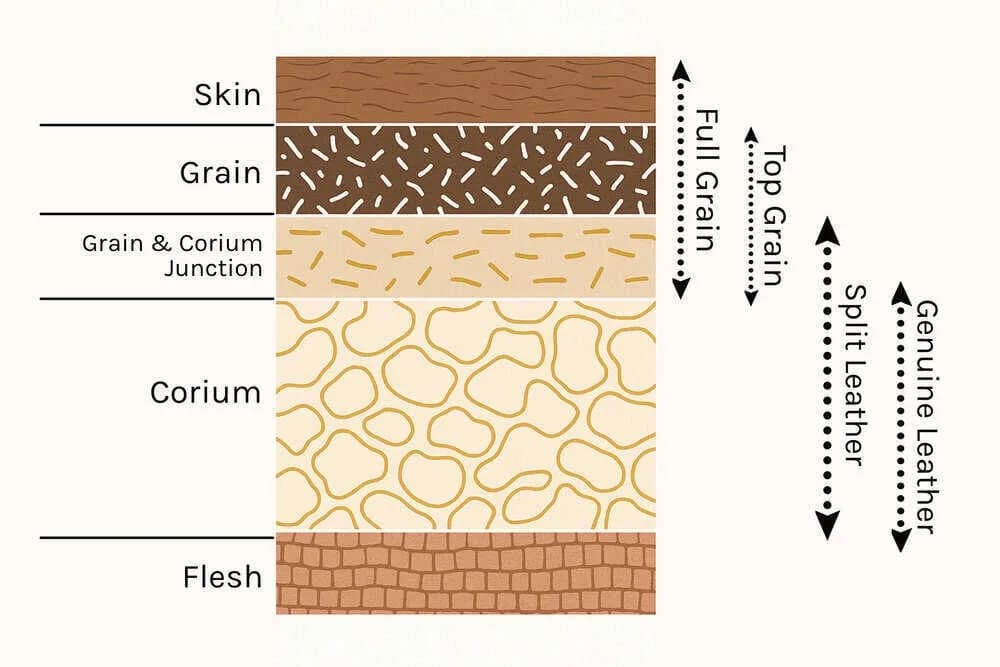
How a Cowhide Is Structured
A bovine hide is a three-dimensional network of collagen fibers. The upper surface has the tightest and most organized fiber structure. This is the grain layer, where the animal’s natural pores, wrinkles, scars, and hair-follicle pattern originate.
Below the grain, the fibers become progressively looser. During leather production, the hide may be passed through a splitting machine and divided horizontally into layers:
The upper grain split contains the original grain surface
A lower flesh split comes from beneath the grain
A particularly thick hide may produce an additional middle split
The grain layer is generally stronger and better able to resist repeated flexing than a lower split of equal thickness. A split can still be useful, but it does not have the same surface structure and should not be represented as full grain or top grain.
Full Grain, Top Grain, Corrected Grain, and Split Leather
These terms describe the layer of the hide and how much the original surface has been altered. They do not describe the coloring system by themselves.
Full Grain Leather
Full grain leather retains the natural grain surface without sanding away the original grain structure. It may show pores, wrinkles, healed scars, insect marks, and variations in grain and color.
Because visible defects cannot simply be removed, manufacturers need cleaner hides and must cut around unacceptable areas. This reduces cutting yield and helps explain why high-quality full grain upholstery leather is expensive.
Full grain can be durable and develop an attractive patina, but it is not automatically the best choice for every sofa. Its performance also depends on thickness, tanning, finish, maintenance, and intended use.
Top Grain Leather
Top grain refers to leather made from the upper grain layer after the hide has been split to the required thickness. Full grain leather is part of the broader top grain category, but top grain can also be lightly buffed, corrected, pigmented, or embossed.
This is why the label “top grain” alone does not confirm that the surface is natural, unfinished, or aniline. It identifies the physical layer, not one specific appearance or quality level.
Corrected Grain Leather
Corrected grain leather is top grain leather whose surface has been buffed or sanded to reduce scars, wrinkles, and other natural variation. Pigment and a protective finish are then applied, and the surface is often embossed with a more uniform grain.
Correction increases cutting yield and creates consistent color and texture. A well-made corrected grain leather can be durable, practical, and appropriate for frequently used furniture. Its value is usually lower than comparable full grain or lightly finished semi-aniline leather because more of the natural surface has been altered.
Split and Coated Split Leather
Split leather comes from the lower portion of the hide. Its exposed surfaces are fibrous because it no longer has the original grain.
A split may be finished as suede or coated with pigment, polyurethane, or another film. It can then be embossed to resemble grain leather. Coated split is real leather underneath the coating, but it should not be confused with top grain leather.
The term “sliced leather” is not a recognized quality grade. Sellers sometimes use it informally for split leather, thin leather, or material cut from a hide. The correct question is whether the product is grain leather, flesh split, coated split, or a reconstituted material.
Aniline, Semi-Aniline, and Pigmented Leather
Aniline, semi-aniline, and pigmented describe how leather is colored and protected. They are finish categories, not animal species or hide layers.
Aniline Leather
Aniline leather is colored primarily with soluble dyes that penetrate the hide without forming an opaque paint layer over the grain. After tanning, the leather is commonly retanned, drum dyed, lubricated with fatliquors, dried, softened, and finished with oils, waxes, or a light transparent protection system.
The natural pores and variations remain visible. Aniline leather feels warm and natural, and it can develop a rich patina. It is also more sensitive to sunlight, spills, body oils, scratches, and uneven fading.
Semi-Aniline Leather
Semi-aniline leather preserves much of the natural appearance while adding a light pigment layer and protective topcoat. It usually offers better stain resistance and more consistent color than pure aniline leather without feeling as heavily coated as standard protected leather.
For premium residential reupholstery, semi-aniline is often the most balanced choice because it combines natural character, comfort, and practical protection.
Pigmented or Protected Leather
Pigmented leather receives an opaque color system and protective topcoat. The finish provides uniform color and better resistance to abrasion, staining, light, and everyday cleaning.
Most family furniture and high-use seating use pigmented leather. Quality varies widely: a thin, flexible finish can perform very well, while an excessively thick or poorly bonded coating may feel plastic-like and eventually crack or peel.
Original and Finished Leather Thickness
A fresh bovine hide is not uniformly thick. The backbone and butt are denser, while the belly and leg areas are thinner and more elastic. Before it becomes upholstery leather, the hide is fleshed, cleaned, tanned, split, and shaved to a controlled gauge.
The unsplit hide may measure several millimeters and can approach roughly 5–10 mm in its heaviest areas. Finished furniture leather is much thinner. A common upholstery range is approximately 0.9–1.4 mm, although lighter and heavier specifications are available.
Thickness alone does not determine quality. Very thick leather can be stiff or unsuitable for tight curves, while leather that is too thin may stretch, telegraph imperfections, or wear through faster. The correct thickness depends on the pattern, seams, cushion design, expected use, and the strength of the selected leather.
How Large Is a Furniture Cowhide?
Leather is sold by surface area because every hide has an irregular outline. A full upholstery hide commonly measures about 45–60 square feet, while especially large hides may exceed that range. A side is approximately half of a full hide.
The stated area is not the same as usable cutting yield. The upholsterer must work around holes, scars, weak belly sections, brand marks, color variation, and shape limitations. Large sofa panels also create more waste than small chair components because they are harder to nest around defects.
Several hides may be required for one sofa. Hides should be selected from the same production lot whenever possible so that color, sheen, thickness, and grain remain consistent across adjoining panels.
How Cowhide Is Cut for Furniture
Furniture leather is usually cut with physical templates, steel-rule dies, or computerized nesting and cutting systems. The operator must consider more than how many pieces fit on the hide.
Important cutting decisions include:
Placing large visible panels in clean, consistent areas
Keeping the direction of stretch compatible across adjoining pieces
Matching grain, color, and sheen on paired cushions and arms
Using denser areas for high-stress or high-wear components
Avoiding weak belly leather in load-bearing sections
Preserving enough material around seams and attachment points
The butt and central back generally provide the firmest, most consistent leather. Shoulder and neck areas may show attractive wrinkles, while belly sections stretch more easily. Skilled cutting improves both appearance and service life; poor placement can make good leather perform badly.
How Leather Is Embossed
Embossing uses heat and pressure to press a grain pattern into the leather. Depending on the production system, the manufacturer may use an engraved plate, a patterned roller, or a continuous press.
A corrected or split surface is typically prepared by buffing, filling, and applying a basecoat. A grain pattern is then pressed into the surface, followed by color effects and a protective topcoat.
Embossing is not automatically a sign of poor quality. It can create consistent appearance, hide minor natural defects, improve cutting yield, or reproduce a specific decorative grain. The key issue is what material lies beneath the pattern and how well the finish is bonded.
How to Identify Furniture Leather Quality
No single visual test can reliably identify every leather type, especially after the furniture has been assembled. A combination of inspection and product documentation is more useful.
Look for the following signs:
Natural grain varies rather than repeating at regular intervals
Full grain and lightly corrected leather may show pores, wrinkles, or small scars
Embossed grain may appear unusually uniform or repeat across panels
A cut edge of top grain leather shows a dense surface transitioning into a fibrous underside
Coated split often shows a distinct surface film over a looser, suede-like fiber layer
Bonded material may reveal a fabric backing or a thin film separating from the substrate
Heavy surface coatings may wrinkle independently from the leather when flexed
A water-drop test is sometimes suggested for identifying absorbent aniline leather, but it should be performed only on an approved sample. Testing an assembled sofa can leave a permanent spot.
The best evidence is a written specification identifying the animal species, hide layer, finish type, thickness, test performance, and whether non-leather materials are used on outside backs or side panels.
Which Cowhide Is Best for Furniture Reupholstery?
The best leather depends on the furniture, household, maintenance expectations, and desired appearance.
| Requirement | Suitable leather |
|---|---|
| Premium natural appearance | Full grain aniline or lightly finished semi-aniline |
| Balance of luxury and protection | Top grain semi-aniline |
| Family sofa or frequently used recliner | Quality pigmented top grain |
| Consistent grain and easier maintenance | Corrected grain top grain |
| Vintage character and patina | Aniline leather, if the owner accepts variation |
| Heavy-use seating | Tested protected leather with strong finish adhesion |
| Tight curves and detailed upholstery | Supple upholstery leather in the correct thickness |
Before ordering, confirm that the hide is intended for upholstery rather than garments, handbags, or saddlery. Ask for abrasion, flex, finish-adhesion, colorfastness, lightfastness, and flame-performance information when those properties matter for the project.
How Furniture Manufacturers Reduce Leather Costs
Modern furniture can be advertised as leather even when premium grain leather is used only in selected areas. Common cost-saving methods include:
Using top grain leather only on seat cushions, inside backs, and arm contact areas
Covering outside backs and side panels with color-matched vinyl or polyurethane
Using coated split on less visible sections
Replacing hide panels with bonded or reconstituted material
Sanding lower-selection hides and applying heavier pigment and embossing
Reducing finished thickness to increase the area obtained from each hide
Dividing large panels into smaller pieces to improve cutting yield
Using vague terms such as “leather seating,” “leather match,” or “genuine leather” without identifying every material
These methods are not always deceptive if the construction is clearly disclosed and the materials are appropriate for their location. The problem is that shoppers often assume the entire piece is upholstered in the same grade of leather.
When Restoration Is Better Than Reupholstery
Faded color, worn topcoat, light scratches, and localized surface damage do not always require replacement of the leather. If the hide remains flexible and structurally strong, professional cleaning, surface repair, recoloring, and protective refinishing may preserve the original upholstery.
Panel replacement or complete reupholstery becomes more appropriate when the leather is brittle, deeply cracked, torn through, severely stretched, contaminated beyond reliable preparation, or failing across multiple panels. Widespread delamination of bonded material cannot be converted into durable grain leather through surface coating.
The frame and cushion construction should also be considered. Reupholstering a strong, well-built sofa can preserve a better piece of furniture than replacing it with a lower-grade product, while a weak frame and collapsed support system may not justify premium new leather.
Choosing Furniture Leather by Specification, Not by Label
Terms such as full grain, top grain, aniline, corrected grain, and split describe different characteristics. They should not be treated as a single ranking from “best” to “worst.”
A practical selection considers the physical layer, surface correction, finish system, thickness, cutting yield, performance testing, and actual use of the furniture. For many homes, quality semi-aniline or protected top grain offers the best balance. Pure aniline is valued for natural beauty and patina, while corrected grain is valued for consistency and easier maintenance.
The most reliable purchase is not the leather with the most impressive marketing name. It is the leather whose construction and performance are clearly documented and appropriate for the furniture it will cover.