
Types Of Leather Used In Handbags: Materials, Thickness, Quality, And Cost
The types of leather used in handbags range from durable cowhide and structured calfskin to soft lambskin, textured goatskin, and rare exotic skins such as alligator, crocodile, python, lizard, ostrich, and stingray.
However, identifying the animal is only the beginning. A handbag’s quality also depends on which part and layer of the hide was used, how thinly the leather was split, how the surface was finished, and whether hidden reinforcement materials support the visible leather.
This guide explains how handbag leather is produced, what full grain and split leather actually mean, which leathers work best for bag bodies and handles, how much different materials cost, and how manufacturers reduce material expenses without making those choices obvious to the customer.
Key Takeaways
Cowhide and calfskin are the most widely used handbag leathers because they offer a useful balance of strength, appearance, availability, and repairability.
Full grain describes leather with its natural grain surface intact. It is not the same as “genuine leather.”
Top grain means leather taken from the upper grain layer, but that surface may be natural, lightly buffed, or heavily corrected.
Split leather comes from the lower layers of a hide and normally needs coatings, embossing, or reinforcement when used on handbags.
Handbag body leather is commonly about 0.8–1.6 mm thick, while handles and load-bearing straps often require 1.6–3.5 mm leather or a laminated construction.
Genuine reptile and exotic skins are normally thinner and smaller than bovine hides, so they often require supporting layers.
An embossed crocodile pattern does not mean the material is crocodile. It may be ordinary cowhide, calfskin, goatskin, or split leather.
The most expensive leather is not automatically the best material for every part of a handbag.
What Determines the Quality of Handbag Leather?
Leather quality cannot be judged by animal species or price alone. Six factors should be considered together:
Species: Cow, calf, goat, sheep, pig, buffalo, horse, reptile, or another animal.
Hide section: Back, bend, shoulder, neck, belly, or flank.
Hide layer: Full grain, corrected grain, or split.
Thickness: The final thickness after splitting and shaving.
Tanning method: Chrome, vegetable, combination, or another tanning system.
Surface finish: Aniline, semi-aniline, pigmented, coated, printed, or embossed.
A thick piece of poor-quality belly leather may stretch more than a thinner piece cut from the back of the same hide. Likewise, a beautifully finished calfskin may be less suitable for an unreinforced shoulder strap than a dense vegetable-tanned cowhide.
Terms such as nappa, Italian leather, genuine leather, and premium leather do not provide enough information on their own. The actual construction matters more than the marketing vocabulary.
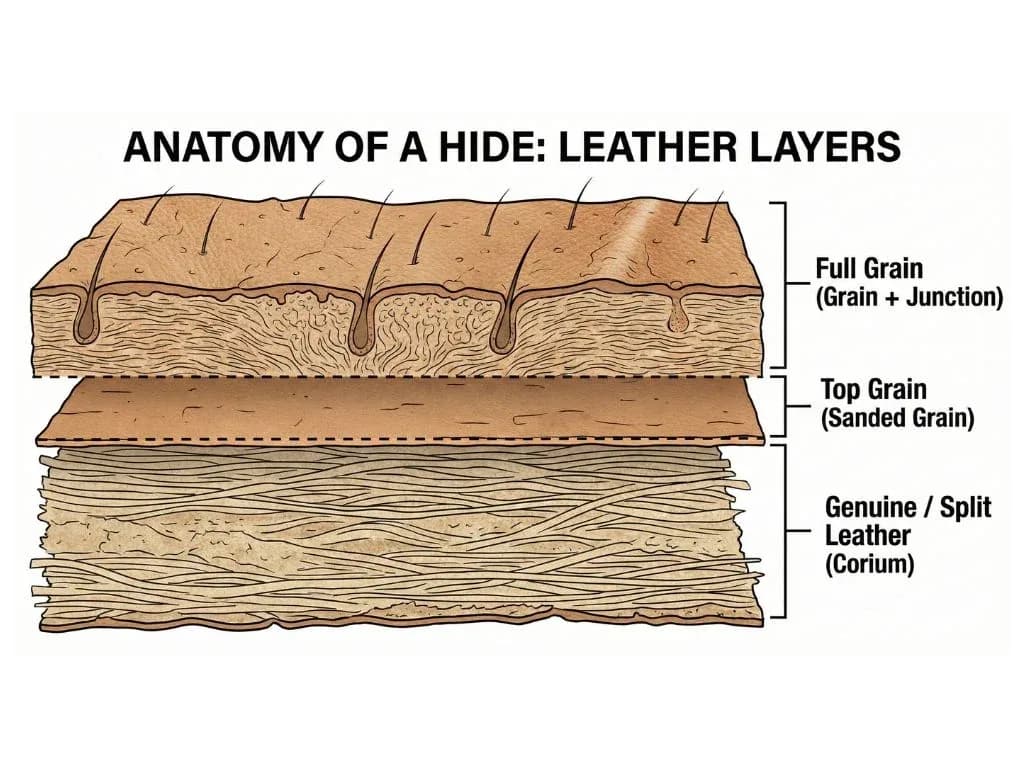
How a Hide Is Divided Into Leather Layers
An animal hide is naturally much thicker than the leather used on most handbags. After tanning or during intermediate processing, tanneries use precision splitting and shaving machinery to produce material of a controlled thickness.
A hide may be several millimeters thick before it is split. Large adult bovine hides can be particularly substantial, although thickness varies across the animal: the back and bend are normally denser, while the belly and flank are thinner and more elastic.
The splitting process produces two principal layers.
Grain Layer
The grain layer is the upper portion of the hide. It contains the natural outer grain surface and the densest collagen fiber structure.
Depending on how the surface is processed, this layer may be sold as:
Full grain leather
Lightly corrected grain leather
Corrected grain leather
Nubuck
Embossed grain leather
Because its fiber structure is comparatively compact, grain leather generally provides better strength, abrasion resistance, shape retention, and aging characteristics than an unsupported lower split.
Flesh Split
The lower portion is commonly called a split, flesh split, or drop split. Its fibers are looser and its surface does not contain the animal’s original grain pattern.
Split leather can be used to make:
Suede
Coated split leather
Pigmented split leather
Embossed split leather
Reinforcement and hidden structural components
Lower-cost handbag panels
A split can still be a useful material, but it should not be represented as having a natural full grain surface.
Full Grain Leather
Full grain leather retains the original grain surface of the hide. The surface has not been sanded deeply enough to remove natural grain characteristics.
It may show:
Pores
Wrinkles
Veins
Small scars
Variations in grain and color
These characteristics do not automatically indicate poor quality. In many cases, they demonstrate that a heavy artificial grain pattern has not been applied.
Full grain leather is valued for its strong upper fiber structure and its ability to develop a natural patina. Nevertheless, a full grain label alone does not guarantee excellent leather. Hide selection, tanning, finishing, cutting, and bag construction still matter.
Top Grain Leather
Top grain is frequently misunderstood as a precise quality grade. Technically, it means that the material comes from the upper grain layer rather than the lower split.
Top grain leather may be:
Full grain
Lightly buffed
Corrected
Pigmented
Printed
Embossed
Therefore, “top grain” does not necessarily mean that the natural surface is completely intact.
Corrected Grain Leather
Corrected grain leather has been buffed or sanded to reduce scars, blemishes, and irregularities. A finish and artificial grain pattern may then be applied.
This creates a more uniform surface and can improve stain resistance. The tradeoff is that heavy correction may reduce the natural depth, transparency, and aging character associated with less-coated leather.
Corrected grain is not automatically inferior. It can be practical for everyday handbags that need consistent color and resistance to water, cosmetics, and handling.
Suede and Nubuck
Suede and nubuck are often confused.
Suede usually has a raised nap created on the flesh side or on a split layer.
Nubuck is produced by lightly abrading the grain side of the leather.
Nubuck is generally finer and may retain a stronger underlying structure, while split suede is typically more porous and flexible. Both materials can absorb oils, water, dye transfer, and dirt more easily than heavily pigmented smooth leather.
Bonded or Reconstituted Leather
Bonded leather is made from leather fibers, trimmings, or shavings combined with binders and formed into a sheet. It is not an intact piece of hide.
The final material may contain a surface coating or film that supplies most of the visible color and texture. Its durability depends on the percentage of leather fiber, type of binder, coating thickness, backing, and manufacturing method.
Bonded leather should not be confused with split leather:
Split leather is a continuous layer cut from an animal hide.
Bonded leather is reconstructed from smaller leather particles or fibers.
In the United States, representations about ground, pulverized, shredded, reconstituted, or bonded leather are addressed by the Federal Trade Commission’s leather product guidance.
Types of Animal Leather Used in Handbags
Cowhide
Cowhide is the most common leather used in handbags. It is widely available, large enough for substantial panels, and suitable for many tanning and finishing methods.
Its properties include:
Good tensile and tear strength
Moderate to firm structure
Broad availability
Good abrasion resistance
Compatibility with embossing and pigmentation
Relatively predictable repair behavior
Cowhide is used for bag bodies, bases, corners, handles, straps, piping, reinforcements, and trim.
The final character depends heavily on tanning. Vegetable-tanned cowhide can be firm and patina-rich, while chrome-tanned cowhide may be softer, lighter, and more flexible.
Calfskin
Calfskin comes from younger cattle. It typically has a finer grain, smoother surface, and more refined hand than adult cowhide.
Calfskin is popular in luxury handbags because it combines elegance with reasonable strength. Common versions include:
Box calf
Grained calfskin
Saffiano-style embossed calfskin
Smooth calfskin
Patent calfskin
Nubuck calfskin
Barenia-style leather
Calfskin works well for structured bag bodies, flaps, gussets, handles, trim, and fine leather goods. Smooth, lightly finished calfskin can show scratches and pressure marks more readily than heavily grained or pigmented leather.
Goatskin
Goatskin is recognizable by its pronounced, pebbled grain. It is strong relative to its weight and often remains flexible even when made quite thin.
Advantages include:
High strength-to-weight ratio
Naturally distinctive grain
Good flexibility
Resistance to repeated bending
Relatively low bulk
Goatskin is used for bag bodies, linings, gussets, wallets, pockets, and occasionally handles. Luxury goatskins such as chèvre are valued for their crisp grain, color saturation, and durability.
Lambskin and Sheepskin
Lambskin is extremely soft and has a smooth, luxurious hand. It is commonly used for quilted handbags, soft clutches, linings, and fashion bags where tactile quality is important.
Its limitations include:
Lower resistance to abrasion
Susceptibility to scratches and fingernail marks
Greater risk of color loss on corners
Sensitivity to oils and moisture
A tendency to stretch if unsupported
Sheepskin may be used for linings, soft bag bodies, and less structural components. The quality varies significantly depending on breed, age, tanning, and finishing.
Lambskin is generally unsuitable for a thin, unsupported load-bearing strap. When used on handles, it is often wrapped around a stronger core.
Pigskin
Pigskin is strong, relatively affordable, and recognizable by groups of visible pores that often appear in triangular patterns.
It is commonly used for:
Handbag linings
Pocket interiors
Suede linings
Reinforcement layers
Lower-cost exterior panels
Pigskin can be durable, but it is less associated with luxury exterior surfaces because of its distinctive pore pattern and market perception.
Buffalo and Bison Leather
Buffalo and bison leathers usually have a bold, irregular grain and a substantial appearance. They are well suited to rugged totes, briefcases, travel bags, and casual leather goods.
They can provide:
Strong visual texture
Good durability
A substantial hand
Rustic aging characteristics
These hides may be less suitable when the design requires an exceptionally smooth, delicate, or highly formal surface.
Horsehide and Shell Cordovan
Horsehide is dense and durable. The best-known specialized material is shell cordovan, which is produced from dense oval-shaped layers located in the horse’s hindquarters.
Shell cordovan is known for:
Very dense fiber structure
High natural luster
Smooth rolling creases rather than fine wrinkles
Exceptional abrasion resistance
High material cost
Limited available panel size
Because shell pieces are relatively small and expensive, they are more common in wallets, watch straps, shoes, and small leather goods than in large handbags. On bags, shell cordovan may be used for flaps, handles, trim, or accent panels.
Deer and Kangaroo Leather
Deerskin is soft, supple, and resilient. It is used selectively for soft bags, linings, fringe, and specialty designs.
Kangaroo leather has an unusually high strength-to-weight ratio and can remain strong when split thin. It is less common in fashion handbags but may appear in performance-oriented or specialty leather goods.
Typical Leather Thickness for Handbags
Leather thickness is often measured in millimeters or ounces. One leather ounce is approximately 0.4 mm, although actual measurements vary slightly.
| Handbag component | Typical finished thickness | Construction notes |
|---|---|---|
| Soft handbag body | 0.7–1.1 mm | Often supported with fabric, foam, or interfacing |
| Structured handbag body | 1.1–1.8 mm | May include board or synthetic reinforcement |
| Gussets and side panels | 0.8–1.5 mm | Must balance flexibility and shape retention |
| Exterior pockets and flaps | 0.8–1.5 mm | Edges may be skived thinner |
| Rolled handles | 0.8–1.4 mm outer leather | Wrapped around rope, cord, tubing, or a leather core |
| Flat handles and straps | 1.6–3.5 mm total | Often laminated from two or more layers |
| Piping | 0.6–1.0 mm covering | Wrapped around a cord |
| Leather lining | 0.4–0.8 mm | Commonly lambskin, goatskin, pigskin, or thin calfskin |
| Bottom and corner panels | 1.2–2.5 mm | Frequently reinforced |
| Small leather goods | 0.8–1.5 mm | Edges are often thinned before folding |
These figures describe common finished materials, not rigid manufacturing rules. A seemingly thick handle may contain thin exterior leather wrapped around a non-leather core. Conversely, a thin leather panel may perform well if it is cut from a dense hide section and supported correctly.
Why Leather Is Skived
Skiving removes thickness from selected areas rather than splitting the entire hide evenly. It is used to:
Reduce bulky folded edges
Create smooth seams
Prepare leather for piping
Join overlapping strap layers
Improve the shape of corners
Produce narrow turned edges
Prevent thick ridges beneath a lining
Poorly controlled skiving can weaken handles, zipper areas, corners, and attachment points. If the leather is made too thin where hardware pulls against it, the part may stretch or tear prematurely.
The Best Leather for Each Part of a Handbag
Different sections of a handbag experience different forces. A suitable body leather may not be the best choice for its handles.
| Bag component | Preferred leather characteristics | Common choices |
|---|---|---|
| Main body | Balanced strength, flexibility, appearance, and weight | Calfskin, cowhide, goatskin, lambskin with reinforcement |
| Handles | Low stretch, good tear resistance, dense fiber structure | Cowhide, calfskin, vegetable-tanned leather, laminated goatskin |
| Shoulder straps | High tensile strength and dimensional stability | Cowhide from the back, bend, or shoulder |
| Bottom | Abrasion resistance and shape retention | Firm cowhide, calfskin, reinforced buffalo |
| Corners | Resistance to rubbing and finish loss | Grained or pigmented calfskin, cowhide |
| Flaps | Flexibility without cracking at fold lines | Calfskin, goatskin, selected lambskin |
| Lining | Low bulk, flexibility, pleasant touch | Goatskin, lambskin, pigskin, thin calfskin |
| Piping | Thin, flexible leather that can wrap around cord | Calfskin, lambskin, goatskin |
| Decorative panels | Appearance and distinctive texture | Exotic skins, embossed calfskin, patent leather |
Best Leather for Handbag Straps and Handles
Handles and straps are load-bearing components. The leather must resist elongation, cracking, sweat, hand oils, abrasion, and repeated flexing.
Dense cowhide cut from the back, bend, or shoulder is generally preferred. Belly leather is more elastic and may stretch, distort, or develop ripples under load.
A high-quality strap may contain:
An exterior leather layer
Internal reinforcement tape
A second leather or textile layer
Edge paint or folded edges
Reinforced stitching around hardware
The visible surface alone does not determine strap strength. If a handle has already stretched, delaminated, or cracked around its core, this guide to repair leather handbag handles explains why surface color alone may not solve the underlying problem.
Aniline, Semi-Aniline, and Pigmented Leather
These terms describe finishing systems, not animal species or hide grades.
Aniline Leather
Aniline leather is colored primarily with transparent dyes, allowing the natural grain and visual variation to remain visible.
It is valued for:
Natural appearance
Soft touch
Color depth
Ability to develop patina
It is also more vulnerable to water spots, oil absorption, fading, and staining.
Semi-Aniline Leather
Semi-aniline leather combines transparent dye with a light protective finish or small amount of pigment. It retains some natural character while offering more practical protection.
This is often a good balance for premium everyday handbags.
Pigmented Leather
Pigmented leather has a more opaque surface coating. It offers:
Consistent color
Greater stain resistance
Better resistance to minor water exposure
Easier production matching between panels
Heavy pigmentation can conceal lower-quality hides, corrections, repairs, or split leather. It can also crack or peel if the coating is too thick or incompatible with the underlying leather.
Exotic Leather Used in Handbags
Exotic leather is valued for rarity, pattern, texture, craftsmanship requirements, and limited usable area. It is not necessarily stronger than cowhide.
Many exotic species are regulated under the Convention on International Trade in Endangered Species of Wild Fauna and Flora. Documentation requirements may apply when exotic leather goods cross international borders.
Alligator, Crocodile, and Caiman
These leathers are used for luxury handbags, flaps, handles, belts, and accent panels.
Alligator generally has relatively smooth, symmetrical belly scales and often shows an umbilical scar.
Crocodile may show small sensory pores within individual scales.
Caiman frequently has harder, bonier scale structures and may be more difficult to cut and finish smoothly.
The belly is usually the most valuable section because it has broad, relatively even scales. Flank and hornback sections produce more dramatic texture but can be harder to shape and stitch.
Reptile leather is often supported with calfskin, goatskin, fabric, or structural board. The exotic skin supplies the visible surface, while hidden layers provide much of the shape and strength.
Python
Python leather is valued for its elongated scale pattern. Depending on finishing direction and use, scale edges may naturally lift slightly.
Python is commonly used for:
Bag bodies
Flaps
Decorative panels
Handles over reinforced cores
Trim
The skin is narrow, so large bags may require several matched skins. Scale matching and panel placement significantly affect material use and cost.
Lizard
Lizard leather has small, regular scales and works especially well for small structured bags, wallets, trim, and handles.
Because the skins are small, producing a large continuous surface requires multiple carefully matched pieces. This makes cutting efficiency and pattern matching important cost factors.
Ostrich
Full-quill ostrich leather is recognized by its raised follicle pattern. It is soft, durable, and flexible, although the most visually desirable quill pattern appears only on part of the hide.
Different sections of the same ostrich hide may therefore have different commercial values.
Stingray
Stingray leather has a hard, bead-like surface. It is highly resistant to abrasion but difficult to cut, thin, sew, and finish.
It is usually used for rigid panels, trim, or decorative inserts rather than soft, highly folded components.
Genuine Reptile Leather vs Embossed Leather
A crocodile, alligator, python, or lizard pattern can be pressed into ordinary leather with heated embossing plates or rollers.
The base material may be:
Full grain cowhide
Corrected grain calfskin
Goatskin
Split leather
Bonded leather
Embossed leather is still genuine leather if its base is genuine leather. It is not, however, genuine reptile leather.
How Embossed Reptile Leather Is Made
A typical process may include:
Selecting or splitting a bovine hide to the required thickness.
Buffing or correcting the surface.
Applying heat, pressure, and an engraved reptile-pattern plate.
Adding base color and contrasting effects.
Applying gloss, matte, wax, or protective topcoat.
Cutting panels to emphasize the most convincing areas of the pattern.
High-quality embossed calfskin can be attractive, durable, and easier to maintain than genuine reptile. The problem arises when a seller uses vague language or photography to imply that the material is an exotic species.
How to Tell Embossed Leather From Genuine Reptile
Look for these clues:
| Characteristic | Genuine reptile | Embossed bovine leather |
|---|---|---|
| Pattern | Naturally variable | May repeat at regular intervals |
| Scale size | Changes across the body | Often unusually consistent |
| Grooves | Structural divisions between scales | Compressed surface pattern |
| Pores | Species-specific details may be present | Printed or absent |
| Cut edge | Scale structure continues through surface | Bovine fiber structure visible underneath |
| Panel symmetry | Requires skilled matching | Can be positioned more easily |
| Price | Usually high | Often similar to other premium cowhide |
| Documentation | May require species information | Normally no exotic-species documentation |
Pattern variation alone is not conclusive because manufacturers can use large, sophisticated embossing plates. Microscopic inspection, edge examination, and documentation may be necessary for high-value items.
Common Leather Marketing Tricks and Cost-Cutting Methods
Cost reduction does not always make a handbag defective. Many efficient constructions are entirely legitimate. The concern is whether the product description allows the customer to understand what is being purchased.
1. Using “Genuine Leather” as a Quality Grade
“Genuine leather” usually means that the material contains real leather. It does not identify:
Animal species
Hide layer
Surface correction
Finish thickness
Leather fiber percentage
Expected durability
A split or heavily coated leather may legally be described as genuine leather in some markets, depending on local labeling rules.
2. Using Premium Leather Only on Visible Panels
A manufacturer may use calfskin or exotic leather on the front flap while using less expensive leather, split leather, textile, or another material on the back, gussets, handle undersides, and interior.
Descriptions such as “calfskin bag” may therefore require closer examination. The same applies to bags that combine coated canvas with natural leather trim, where vachetta leather care and restoration may be relevant even if the main body of the bag is not leather.
3. Splitting Leather Extremely Thin
Thin leather increases the usable area obtained from a hide and reduces weight. It may then be laminated onto fabric, foam, board, or another backing.
This is not automatically poor construction. Many structured luxury bags rely on reinforcement. Problems arise when the leather becomes too thin to tolerate wear, repair, or repeated flexing.
4. Applying a Heavy Coating
An opaque finish can conceal:
Natural defects
Color inconsistency
Corrected grain
Panel mismatch
Lower-grade split leather
Previous surface damage
Heavy coatings can provide excellent stain resistance, but they may eventually crack, peel, or separate from the leather.
5. Embossing a Uniform Grain
Artificial pebble or reptile patterns make large quantities of leather look consistent. Embossing can also conceal surface correction and allow more of the hide to be used.
Embossing itself is not a defect. Premium leathers are also embossed. It should simply not be confused with a natural grain pattern or exotic species.
6. Using Belly Leather in Load-Bearing Parts
Belly leather is generally looser and more elastic than material cut from the back or bend. Using it for long straps may lead to stretching and distortion.
Manufacturers may compensate with reinforcement, but a weak or poorly anchored internal layer can still fail.
7. Hiding Bonded Materials Inside Handles
A handle can look substantial while containing cardboard, low-density filler, bonded material, plastic tubing, or a weak rope core.
The exterior leather may remain intact while the internal construction collapses or breaks.
8. Calling Every Soft Leather “Nappa”
Nappa originally referred to a particular style of soft gloving leather, but the term is now used broadly. It does not guarantee a specific species, grain layer, tanning system, or quality level.
9. Using “Italian Leather” Without More Detail
Italian tanneries produce some of the world’s most respected leathers, but “Italian leather” does not itself reveal the animal, tannery, hide layer, finish, or grade. It may describe the place of tanning rather than the origin of the animal.
10. Using Vague Exotic-Looking Descriptions
Terms such as “croc effect,” “python style,” “alligator pattern,” and “reptile finish” normally describe appearance, not animal species.
A genuine exotic product should have clear species information and, where applicable, the correct trade and import documentation.
How Much Do Different Handbag Leathers Cost?
Leather prices vary according to country, tannery, grade, color, finish, volume, hide size, certification, and supplier markup. Standard leathers are often sold by square foot or square meter, while exotic skins may be priced by skin or by width.
The following ranges are broad retail material estimates rather than handbag prices:
| Leather type | Approximate retail material range |
|---|---|
| Standard finished cowhide | $4–$12 per sq. ft. |
| Premium vegetable-tanned cowhide | $12–$25+ per sq. ft. |
| Luxury calfskin | $15–$30+ per sq. ft. |
| Goatskin | $4–$12 per sq. ft. |
| Luxury chèvre goatskin | $10–$20+ per sq. ft. |
| Lambskin | $7–$18+ per sq. ft. |
| Pigskin | $1–$7 per sq. ft. |
| Buffalo leather | $7–$15 per sq. ft. |
| Deer or specialty kangaroo leather | $15–$25+ per sq. ft. |
| Shell cordovan | $55–$100+ per sq. ft. equivalent |
| Crocodile-embossed cowhide | $6–$30 per sq. ft. |
| Caiman | Approximately $60–$200+ per skin |
| Python | Approximately $40–$250+ per skin |
| Lizard | Approximately $45–$100+ per skin |
| Stingray | Approximately $30–$150+ per skin |
| Ostrich | Approximately $300–$600+ per skin |
| Premium alligator or crocodile | Approximately $150–$1,100+ per skin, with exceptional skins costing more |
The amount of leather purchased is always greater than the visible area of the finished handbag. Manufacturers must allow for natural defects, cutting direction, panel matching, scale symmetry, reinforcement, testing, and production waste.
A small exotic skin may also be expensive to use because several skins must be matched to complete a single bag.
Why the Most Expensive Leather Is Not Always the Most Durable
Material value and practical durability are not the same.
Lambskin may be more luxurious to touch than heavily pigmented cowhide, but it will usually show scratches sooner. Genuine python may be rarer than calfskin, but its scale structure may require more careful handling. Aniline leather may develop a beautiful patina, yet absorb liquids more readily than a pigmented surface.
The best material depends on the intended use:
Daily commuter bags benefit from abrasion resistance and stable color.
Evening bags may prioritize softness, sheen, or rarity.
Travel bags need strong handles, corners, and bottom panels.
Collectible bags may prioritize historically correct material and finish.
Restoration projects require compatibility between the original leather and any replacement or coating system.
How Leather Type Affects Handbag Repair
Before repairing a handbag, a specialist must identify more than its color. The assessment should consider:
Animal species
Grain or split construction
Surface coating
Thickness
Absorbency
Flexibility
Previous repairs
Hidden reinforcement
Pattern and gloss level
This is one reason Why luxury handbag repair requires specialist. A treatment that performs well on pigmented cowhide may permanently darken aniline calfskin, flatten suede, stain lambskin, or damage python scales.
Corner Wear
Corners normally show damage before flat panels because they experience repeated abrasion and flexing. The finish may wear away first, followed by the grain layer and eventually the underlying fiber structure.
The correct method to repair scuffed leather handbag corners depends on whether the damage is limited to the finish or has already removed part of the leather.
Cracks, Scratches, and Fading
Owners often seek help for problems like cracks, scratched or faded handbags, but these symptoms can come from very different causes.
A visible crack may be:
A crack in the surface coating
A broken grain layer
A crease caused by collapsed reinforcement
Delamination between leather and backing
A failed previous repair
Successful restoration depends on treating the actual layer that has failed.
Handles and Straps
Handles absorb hand oils, perspiration, cosmetic residue, edge abrasion, and constant mechanical loading. Damage may extend beneath the visible leather into the core or reinforcement.
Recoloring the surface will not correct a broken core, stretched attachment, or separating laminated strap. Structural problems must be stabilized before cosmetic finishing.
Exotic Leather Repair
Exotic leather requires species-specific methods. Repairs may need to preserve:
Scale direction
Natural gloss
Flexible joints between scales
Follicle texture
Pattern alignment
Original finish transparency
Aggressive sanding or heavy pigment can erase the features that give exotic leather its value.
How to Evaluate Handbag Leather Before Buying
Use the following checklist when examining a handbag.
Read the Material Description Carefully
Look for specific terms such as:
Calfskin
Goatskin
Lambskin
Cowhide
Full grain
Split leather
Bonded leather
Embossed calfskin
Genuine alligator
Genuine python
A description that only says “leather” provides limited information.
Examine Several Parts of the Bag
Compare the front, back, gussets, bottom, handles, handle undersides, piping, and interior. Different materials may have been used in each area.
Inspect the Grain Pattern
Natural grain usually varies. Perfectly uniform or regularly repeating texture may indicate embossing, although high-quality embossing can be difficult to identify without magnification.
Look at Cut Edges and Stitch Holes
Where visible, leather edges can reveal a fibrous internal structure, heavy coating, bonded construction, or laminated backing.
Do not damage the bag to perform this test.
Gently Assess Flexibility
Natural leather normally forms softer, irregular folds when flexed. A heavily coated leather may form sharper creases because the surface film controls how the material bends.
This test is not conclusive and should not be performed aggressively on a valuable bag.
Ask About Finish and Care Requirements
Aniline, suede, nubuck, lambskin, patent, and exotic leather require different care. A seller should be able to provide more than a generic recommendation to “use leather conditioner.”
Request Documentation for Exotic Species
For high-value exotic handbags, request the species name, proof of authenticity, and any documents required for international transport or resale.
Frequently Asked Questions
What is the best leather for handbags?
Calfskin is one of the best all-around choices for premium handbags because it combines a refined grain with useful strength. Cowhide is better for rugged or heavily loaded bags, goatskin is excellent when low weight and flexibility are important, and lambskin is chosen primarily for softness and luxury.
There is no single best leather for every handbag.
Is full grain leather better than top grain leather?
Full grain leather retains its natural grain surface. Top grain is a broader term for leather taken from the upper grain layer and may include full grain or corrected leather.
Full grain often provides excellent aging characteristics, but a well-made corrected top grain leather may be more practical for a stain-resistant everyday handbag.
Does “genuine leather” mean high quality?
No. Genuine leather indicates that real leather is present, but it does not identify the species, layer, finish, thickness, or construction quality.
What leather thickness is best for a handbag?
Main body panels are commonly about 0.8–1.6 mm thick. Handles and straps usually require a thicker total construction of approximately 1.6–3.5 mm, often created by laminating multiple layers or adding reinforcement.
Is calfskin more durable than lambskin?
Calfskin is generally more resistant to abrasion, stretching, and surface damage. Lambskin is softer and more delicate. A pigmented or grained calfskin is normally easier to use as an everyday bag than lightly finished lambskin.
What leather should be used for handbag handles?
Dense cowhide or calfskin cut from the back, bend, or shoulder is usually preferred. The construction should also include appropriate reinforcement and secure attachment points.
Is embossed crocodile leather real leather?
It can be. If the base is cowhide or calfskin, it is genuine leather with an embossed crocodile pattern. It is not genuine crocodile leather.
If the base is bonded leather, the description should disclose that construction rather than implying an intact hide.
How can I tell genuine crocodile from embossed cowhide?
Genuine crocodile normally has natural variation in scale size and may show sensory pores, depending on the species. Embossed cowhide may display repeating patterns and bovine fiber structure at the edges.
For an expensive purchase, visual inspection should be supported by documentation or professional authentication.
Is bonded leather suitable for handbags?
Bonded leather can be used for low-cost fashion goods and internal components. Its lifespan depends strongly on its fiber content, binder, backing, and surface coating. It generally has less repair potential than intact grain leather.
Can damaged handbag leather be restored?
Many scratches, worn corners, faded areas, edge problems, stains, and damaged handles can be improved or restored. The available result depends on whether the damage affects only the finish or extends into the grain, lower leather fibers, stitching, or internal structure.
Final Thoughts
The best way to understand a leather handbag is to look beyond the animal name and examine the entire material system: hide section, grain layer, thickness, tanning, finish, reinforcement, and placement on the bag.
Calfskin, lambskin, cowhide, goatskin, and exotic skins each have legitimate advantages. Full grain is valuable for its intact surface, while corrected and pigmented leathers can offer useful consistency and protection. Split and bonded materials reduce costs, but their presence and limitations should be communicated accurately.
If you are considering the purchase or restoration of a valuable handbag, material identification should come before cleaning, conditioning, recoloring, or structural work.
For a professional assessment, visit our leather handbag repair service and send clear photographs of the bag’s front, back, sides, bottom, corners, handles, straps, hardware, and interior.