
Why Luxury Handbag Repair Requires A Specialist
Why Should You Choose a Handbag Repair Specialist Instead of a Furniture Leather Repair Company?
Leather furniture restoration and luxury handbag restoration may appear to be closely related services. Both involve leather, color matching, cleaning, surface repair, and occasionally the replacement of damaged material.
However, the similarities largely end there.
A leather sofa is a large upholstered structure. A luxury handbag is a compact, load-bearing object assembled from numerous small components, often combining several types of leather, fabric, edge coating, reinforcement, thread, adhesives, hardware, and decorative finishes.
The question is therefore not whether a company also repairs furniture. The more important question is:
Who will actually work on the handbag, and what type of restoration are they trained to perform?
A company can successfully provide both furniture restoration and handbag repair, but the work should be assigned to separate specialists. Techniques, coatings, tools, construction knowledge, and acceptable tolerances differ significantly between the two fields.
Using furniture-restoration methods on a designer handbag can change the leather’s softness, conceal its natural grain, damage delicate finishes, weaken structural components, or make a small repair far more visible than the original damage.
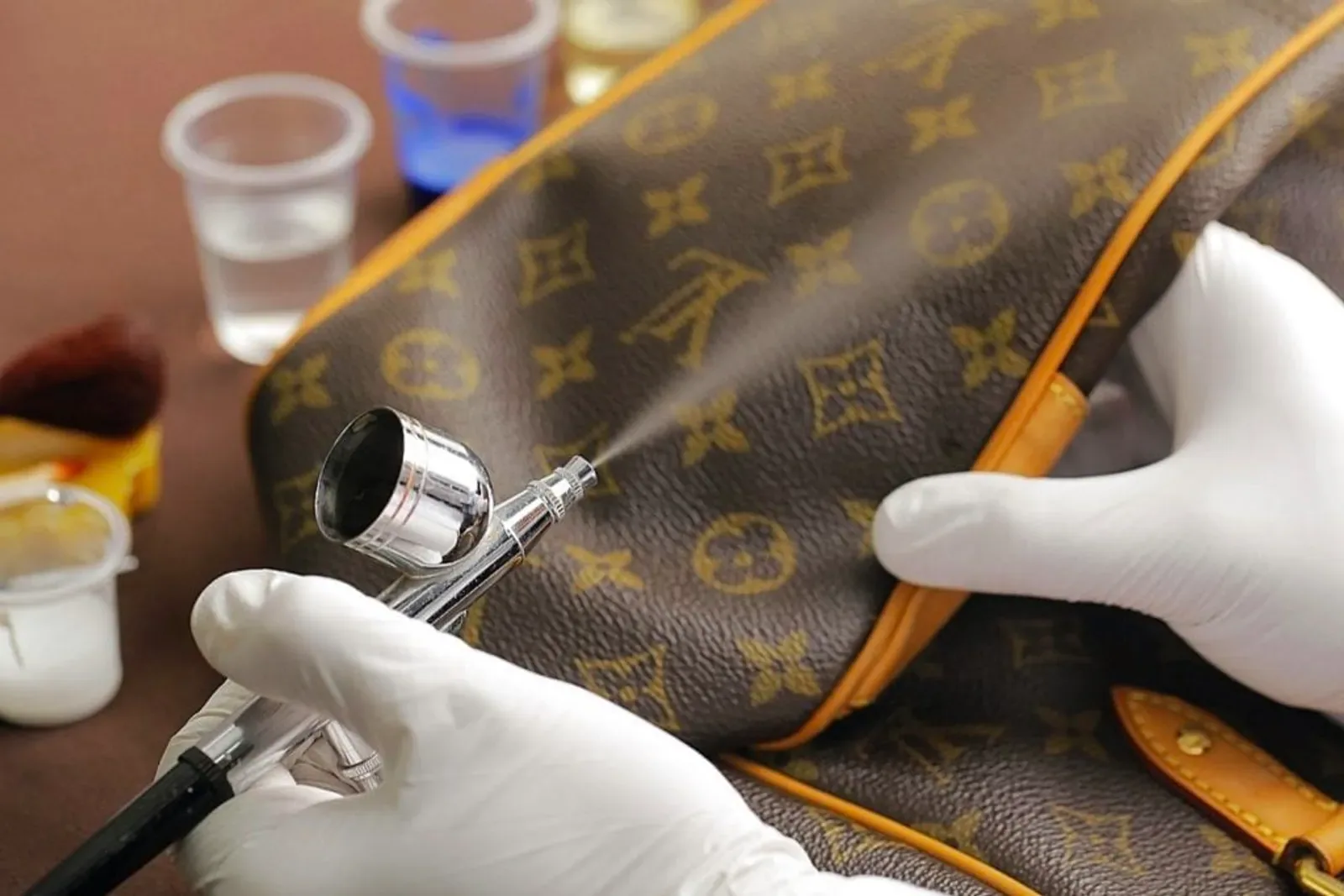
Leather Repair Is Not One Universal Profession
The term “leather repair” covers several very different disciplines.
A furniture leather technician may be highly skilled at restoring large seating surfaces, removing body-oil contamination, repairing cuts, recoloring cushions, replacing upholstery panels, and working with sofa frames and support systems.
Those abilities do not automatically include:
Reconstructing handbag corners
Rebuilding handles and strap anchors
Replacing leather woven through a chain
Reproducing narrow piping
Restoring edge coating or glazing
Opening and rebuilding structured handles
Working around plated hardware
Matching miniature stitch patterns
Replacing internal reinforcement
Preserving embossed logos and heat stamps
Reconstructing a bag without changing its proportions
These are separate construction skills.
Handbag restoration is much closer to precision leatherwork than to broad surface refinishing. The technician must understand not only how leather behaves, but also how a particular bag was assembled and how each component supports the others.
Luxury Handbags Use a Wide Range of Materials
It is inaccurate to say that every luxury handbag is made from the same type of leather. Even bags produced by the same brand may require completely different restoration processes.
Designer handbags may incorporate:
Lambskin
Calfskin
Goatskin
Vachetta leather
Suede
Nubuck
Patent leather
Embossed or coated leather
Alligator, crocodile, lizard, or snakeskin
Coated canvas
Textile canvas
Velvet, tweed, or other fabrics
Painted or plated metal hardware
Edge coatings and flexible glazing
Structural board and internal reinforcement
CHANEL’s own care materials distinguish among lambskin, patent leather, suede, nubuck, calfskin, goatskin, fabric, and other materials. The company also warns that unsuitable care products can alter a handbag’s finish.
Gucci similarly provides different care instructions for leather, coated fabric, nylon, canvas, velvet, and suede rather than recommending one universal treatment.
Louis Vuitton distinguishes between coated canvas and natural leather and warns against applying common leather lotions, mink oil, perfume, chemicals, and other home remedies to its canvas products.
A product that works properly on one material may stain, stiffen, dissolve, discolor, or permanently change another.
That is one of the principal reasons a handbag must be identified and tested before restoration begins.
Why Lambskin Requires Particular Care
Lambskin is used in many luxury handbags because of its softness, smooth grain, and refined appearance. It is also considerably less forgiving than many protected furniture leathers.
Pressure, fingernails, chain straps, clothing, improper cleaners, and aggressive preparation can leave visible marks. CHANEL specifically advises avoiding care products that may alter the finish of its handbags and provides separate instructions for marks on lambskin. The brand also identifies lambskin, patent leather, suede, and nubuck as materials that can be particularly sensitive to color transfer.
A process designed for a heavily protected furniture surface may be too aggressive for delicate lambskin. Strong degreasers, excessive abrasion, thick pigment application, or an unsuitable topcoat can change:
The softness of the leather
The visibility of the natural grain
The surface sheen
The way the leather folds
The depth and character of the original color
The feel of the bag in the hand
The objective is not merely to cover a scratch or worn area. The restored section must remain visually and physically consistent with the surrounding leather.
Handbag Construction Is Fundamentally Different From Upholstery
Furniture leather is usually stretched and secured over foam, cushions, or a rigid frame. Repairs frequently involve relatively large, accessible surface areas.
A handbag is constructed from small panels joined under tension and reinforced at precise locations. A single area may contain:
Outer leather
Lining material
Reinforcement
Folded or skived leather edges
Adhesive
Stitching
Piping
Hardware
Edge coating
Opening one component can affect several others.
For example, replacing a handle may require the specialist to open the lining, access hidden anchors, remove hardware without damaging its finish, reproduce the original handle dimensions, install reinforcement, follow existing stitch holes where appropriate, and close the bag without leaving evidence of the work.
A repair can be cosmetically attractive and still be structurally incorrect.
The new handle may be too thick, too rigid, too long, or improperly balanced. An anchor may appear secure but fail when the bag is filled. A replacement tab may pull the body of the bag out of shape because the material or reinforcement does not match the original construction.
These are not typical furniture-repair problems.
Handle and Strap Repair Is Structural Work
Handles and straps are among the most heavily stressed parts of a handbag.
They carry the weight of the bag and its contents while repeatedly bending around the hand, shoulder, hardware, and connection points. Body oil and hand cream can also penetrate handle leather, especially on untreated natural trims that require careful vachetta leather care and restoration, while friction gradually wears the finish and edge coating.
Depending on the condition, a specialist may need to:
Clean and stabilize the original handle
Extract body-oil contamination
Restore the color and finish
Replace internal tubing
Rebuild a damaged base
Reinforce an attachment point
Restitch the original construction
Manufacture a completely new handle or strap
Transfer and reinstall reusable original hardware
A new component must match more than the general color.
The specialist must consider its:
Length
Width
Thickness
Grain
Flexibility
Edge profile
Stitch spacing
Reinforcement
Position relative to the bag
Load-bearing capacity
Even a small difference can change the appearance and balance of a luxury handbag.
Corner Restoration Is More Than Applying Color
Handbag corners are exposed to constant abrasion. They rub against clothing, tables, floors, car seats, and other surfaces.
Minor corner wear may affect only the original color and protective finish. More advanced wear can flatten the grain, expose leather fibers, damage piping, weaken seams, or remove material from the structure itself.
These conditions require different solutions.
A surface-level recoloring may be appropriate when the leather remains structurally intact. When fibers or piping have been lost, simply applying pigment over the area may hide the damage temporarily without restoring the original shape or strength.
Professional corner restoration may involve:
Cleaning and contamination removal
Stabilizing exposed fibers
Reconstructing the original contour
Repairing or replacing piping
Reproducing the grain
Matching the color and undertone
Restoring the correct sheen
Applying a flexible protective finish
Furniture technicians are not normally required to reconstruct small corners to the same visual tolerance. On a handbag, even a slight difference in profile, texture, or color can be immediately noticeable.
Glazing and Edge Coating Are Separate Specialties
Many handbags have exposed leather edges on handles, straps, tabs, openings, piping, and decorative components.
These edges may be finished with a flexible coating commonly called edge paint or glazing. The coating creates a smooth appearance while helping protect the exposed edge from friction, moisture, and separation.
Over time, glazing can:
Crack
Peel
Become sticky
Separate from the leather
Wear away
Develop an uneven or excessively thick appearance
Proper restoration usually requires more than painting over the damaged coating.
The unstable glazing must be carefully removed or prepared without cutting into the leather. The edge may need to be reshaped, compressed, stabilized, and rebuilt with multiple controlled layers. The new coating must match the original color, thickness, flexibility, sheen, and edge profile.
Furniture restoration rarely contains an equivalent process. Upholstery leather is generally wrapped around panels and secured beneath the furniture rather than presented through numerous narrow, exposed, decoratively finished edges.
A furniture colorant or generic paint may be completely inappropriate for handbag glazing.
Color Matching Must Be More Precise on a Handbag
Large furniture surfaces are normally viewed from several feet away. A handbag is carried in the hand, examined closely, photographed, and often evaluated under different lighting conditions.
A minor mismatch that might be unnoticeable on a sofa can be obvious on the corner or handle of a luxury bag.
Accurate handbag color matching must account for:
Base color
Undertone
Saturation
Opacity
Grain visibility
Surface sheen
Natural color variation
Age and patina
Lighting conditions
The original protective finish
“Black,” “brown,” “beige,” and “red” are not precise color specifications.
A black Chanel lambskin finish may not resemble a black Prada calfskin finish. Two brown Louis Vuitton leathers may differ because of age, oxidation, use, and patina. Hermès notes that leather naturally evolves, softens, changes color, and develops patina over time.
The objective is not always to make an old bag look uniformly new. On vintage or collectible pieces, an excessively opaque repair can erase natural age variation and make the restored area more conspicuous.
Every Brand Has Its Own Construction Language
Luxury brands do not use one standardized combination of leather, thread, hardware, edge coating, and construction.
Each house—and often each collection—has its own specifications.
Examples include:
CHANEL lambskin, quilting, braided chain straps, and structured flap construction
Hermès leathers, saddle-stitching traditions, handle construction, and carefully developed patina
Louis Vuitton coated canvas, natural cowhide trim, piping, and brand-specific hardware
Dior lambskin, Cannage stitching, rounded handles, and structured panels
Bottega Veneta woven leather constructions such as Intrecciato
Gucci combinations of leather, coated fabric, canvas, suede, textiles, and decorative hardware
Dior describes the Lady Dior as a soft-lambskin bag with Cannage topstitching and rounded handles, while Bottega Veneta identifies its woven Intrecciato construction as a defining feature of many bags. (Dior)
These examples illustrate why the brand and model should be identified before a restoration plan is developed.
The repair method should follow the construction of the bag rather than forcing every bag into one standardized procedure.
Why Furniture Products Can Damage a Luxury Bag
Furniture restoration products are not inherently poor products. They are simply developed for a different application.
A system intended for large protected upholstery panels may create unacceptable results on a small, delicate handbag component.
Potential problems include:
Excessive coating thickness
Loss of natural grain
A hard or plastic-like surface
Incorrect gloss
Color transfer
Cracking at folds
Stiff handles or straps
Darkening of absorbent leather
Visible repair boundaries
Damage to adjacent textiles or hardware
Adhesion failure on patent or coated surfaces
Manufacturer care instructions repeatedly caution against applying unsuitable products. Hermès states that ordinary market care products may not be adapted to its leathers, while CHANEL advises avoiding products that could alter a bag’s finish. (Hermès)
The Canadian Conservation Institute also notes that museum practice minimizes indiscriminate use of leather dressings, lubricants, and cleaners because inappropriate treatments can have negative long-term effects. (Canada)
Professional handbag restoration therefore begins with identification and testing, not with choosing a universal cleaner or color from a shelf.
An Incorrect Repair Can Cost More to Reverse
One of the most difficult handbag-restoration projects is correcting previous work.
We regularly encounter bags that have been treated with:
Thick furniture pigment
Household or craft paint
Permanent marker
Shoe polish
Aggressive solvent
Superglue
Generic adhesive
Heavy filler
Incorrect edge paint
Nonmatching leather
Improperly installed hardware
The original damage may have been small. After an unsuitable repair, the specialist must address both the original problem and the new material applied over it.
Removing an incorrect coating may also remove part of the original finish. Hardened adhesive can penetrate leather fibers. New stitch holes cannot simply be erased. Aggressive sanding may permanently flatten or remove the grain.
This is why the cheapest initial repair may ultimately become the most expensive option.
A responsible specialist should know when to intervene, when to preserve the original material, and when a repair would create more risk than benefit.
How Museum-Restoration Experience Influences Handbag Work
Museum restoration is not the same as everyday commercial handbag repair. However, conservation experience develops several principles that are valuable when working with vintage, collectible, or historically important pieces.
These include:
Identifying materials before treatment
Testing products in an inconspicuous area
Avoiding unnecessary intervention
Preserving original material whenever practical
Documenting the item’s condition
Considering how a treatment may age
Avoiding products that could create irreversible damage
Distinguishing stabilization from purely cosmetic alteration
The objective is not always to remove every sign of age.
A collectible bag may benefit from retaining controlled patina, original stitching, hardware wear, and other evidence of its history. Replacing too much can reduce its character and may affect its appeal to collectors.
Our handbag specialists combine practical repair experience with principles informed by museum restoration. Each bag is evaluated according to its material, age, intended use, market position, and personal importance to the owner.
Does This Mean a Furniture Restoration Company Cannot Repair Handbags?
No.
A company may provide both furniture and handbag restoration successfully. The determining factor is whether it maintains distinct specialists, materials, tools, and procedures for each type of work.
Furniture should be handled by technicians trained in:
Upholstery leather
Frames and suspension systems
Cushion construction
Large-area color restoration
Body-oil extraction
Panel replacement
Reupholstery
Handbags should be handled by specialists trained in:
Small leather goods construction
Delicate and specialty materials
Handles and straps
Corners and piping
Glazing and exposed edges
Linings and internal reinforcement
Hardware
Fine stitching
Brand-specific finishes
Our company provides both services, but we do not treat them as the same discipline. Handbags are assigned to dedicated craftsmen who work specifically with bags and small leather goods.
Should You Contact the Original Brand First?
In some situations, yes.
When a handbag is new, covered by a manufacturer’s warranty, or eligible for an official aftercare program, contacting the brand first may be the appropriate option.
Several luxury houses provide their own repair services:
CHANEL offers handbag care and restoration services and provides a five-year warranty for qualifying bags and wallets on chain purchased from April 2021.
Hermès accepts items for maintenance and repair through its craftspeople and workshops.
Louis Vuitton operates dedicated repair ateliers and offers an online repair-request process.
Gucci accepts assistance and repair requests through its Client Service team, boutiques, and authorized retailers.
Bottega Veneta provides repair services performed by its artisans for eligible products.
An independent handbag specialist may become relevant when the bag is outside the applicable warranty, the requested repair is not offered by the brand, the item is vintage, the original owner documentation is unavailable, or the client wants to evaluate additional restoration options.
Before authorizing third-party work on a new or collectible handbag, the owner should check the manufacturer’s current warranty and repair terms.
What Should You Ask a Handbag Repair Specialist?
Before entrusting a valuable bag to any restoration company, ask questions that reveal how the work will actually be performed.
Who will work on the bag?
Confirm that the item will be assigned to a handbag specialist rather than automatically passed to a general leather technician.
Have you worked with this brand and material?
Experience with one type of leather does not guarantee experience with lambskin, vachetta, patent leather, suede, coated canvas, or exotic skin.
Will the original material be preserved?
A specialist should explain whether the component can be restored, must be reinforced, or requires replacement.
How will the color and finish be matched?
The answer should address grain, sheen, flexibility, and undertone—not only the general color name.
Will any original components be removed?
Ask what will happen to the original handles, hardware, lining, piping, and reinforcement.
Is the proposed repair cosmetic or structural?
A surface treatment should not be presented as a structural repair.
What limitations should I expect?
A responsible specialist should explain what can be corrected, what can only be improved, and what may remain visible.
Is the bag insured?
For valuable items, ask about insured shipping, handling procedures, documentation, and signature-confirmed return delivery.
How We Approach Luxury Handbag Restoration
Every project begins with an evaluation of the complete bag rather than only the most visible damaged area.
We consider:
Brand and model
Age and previous repairs
Leather or material type
Original finish
Structural condition
Hardware
Stitching
Lining
Handle and strap attachments
Corners and piping
Glazing
Intended future use
Collectible or sentimental value
We then determine whether the best solution is cleaning, stabilization, color restoration, component reconstruction, leather replacement, stitching, lining work, hardware service, or a combination of treatments.
Our handbag specialists have extensive experience with premium brands including Louis Vuitton, Hermès, CHANEL, Gucci, Prada, Dior, Bottega Veneta, Saint Laurent, Fendi, Goyard, Celine, Loewe, Burberry, Balenciaga, and others.
The objective is not to apply the maximum amount of restoration. It is to perform the amount of work necessary to create a durable, visually appropriate result while preserving as much of the original bag as reasonably possible.
Frequently Asked Questions
Can a furniture leather repair technician restore a handbag?
A furniture technician may also possess handbag experience, but furniture expertise alone is not sufficient. Ask whether the person performing the work has specific training and a portfolio involving handbag construction, delicate leather, handles, straps, corners, glazing, hardware, and linings.
Are luxury handbags mostly made from lambskin?
No. Lambskin is common in certain luxury collections, but designer handbags may also use calfskin, goatskin, vachetta, suede, patent leather, exotic skins, coated canvas, textiles, or combinations of several materials.
Why are handbag handles difficult to repair?
Handles are load-bearing components. A repair must account for leather strength, internal reinforcement, hardware, balance, dimensions, stitch placement, flexibility, and the weight the handle will carry.
Can worn handbag corners simply be recolored?
Only when the damage is limited to the finish. If the leather fibers, piping, seam, or internal structure are damaged, the area may need stabilization or reconstruction before color is applied.
What is handbag glazing?
Glazing is the flexible finished coating applied to many exposed leather edges, including handles, straps, tabs, and openings. Damaged glazing generally must be prepared or removed and rebuilt in controlled layers rather than covered with one coat of paint.
Can an incorrect handbag repair be reversed?
Some previous repairs can be removed or corrected, but complete reversal is not always possible. Strong adhesive, deep sanding, new stitch holes, staining, or damage to the original grain may permanently alter the bag.
Will professional restoration affect the bag’s value?
The effect depends on the brand, model, rarity, condition, and type of treatment. Conservative, well-documented restoration may improve usability and appearance, while excessive refinishing, incorrect materials, or unnecessary replacement can affect collector interest. The restoration goal should be discussed before work begins.
Choose the Specialist, Not Simply the Service Category
The words “leather repair” do not guarantee that a technician is qualified to restore every leather object.
Furniture and handbags require different materials, tools, tolerances, construction knowledge, and restoration strategies. A skilled furniture technician may be the correct person for a sofa and the wrong person for a lambskin handbag. Likewise, a handbag specialist may not be qualified to rebuild a recliner frame or perform large-scale upholstery work.
The company’s complete service list is less important than the experience of the individual specialist assigned to the project.
When the handbag is valuable, collectible, difficult to replace, or personally important, ask who will perform the work, what materials will be used, how the original construction will be preserved, and what limitations should be expected.
The correct repair should not merely make the damage less visible. It should respect the material, structure, design, and value of the bag.
Request a Handbag Restoration Assessment
Send clear photographs of the front, back, sides, bottom, corners, handles, straps, interior, hardware, and every damaged area.
Our handbag specialists will evaluate the material and construction, explain which components can be restored, identify anything that may require replacement, and provide an estimate before work begins.