
Fabric Upholstery Repair: What Can Be Repaired Without Full Reupholstery?
A damaged couch or chair does not always need complete reupholstery.
Sometimes the fabric itself is still in good condition and only one part has failed: a seam has opened, one panel is damaged, a button is missing, or a cushion has lost its shape.
In those cases, upholstery repair can preserve most of the original furniture while correcting only the areas that actually need work.
That can mean a small seam repair.
It can mean opening a cushion and rebuilding the stuffing.
Or it can mean removing and replacing one complete fabric section while leaving the rest of the piece untouched.
The right solution depends on how the furniture was constructed and where the damage is located.
A Torn Seam Is Not the Same as Torn Fabric
One of the most common upholstery problems is an open seam.
This often happens on seat cushions, back cushions, armrests, or high-stress areas where two upholstered panels are joined.
If the fabric itself is still strong, the repair can be relatively straightforward.
The damaged seam is opened enough to access the original construction, weakened thread is removed, the fabric edges are repositioned, and the section is sewn back together.
The important question is whether the original fabric still has enough strength around the seam.
If the thread failed, seam repair may be enough.
If the fabric itself is fraying or tearing along the stitching line, simply sewing it again may not provide a durable result.
In that situation, reinforcement or partial fabric replacement may be required.
Partial Fabric Replacement Can Save the Rest of the Furniture
Fabric upholstery often fails unevenly.
The seat may be worn while the back still looks almost new.
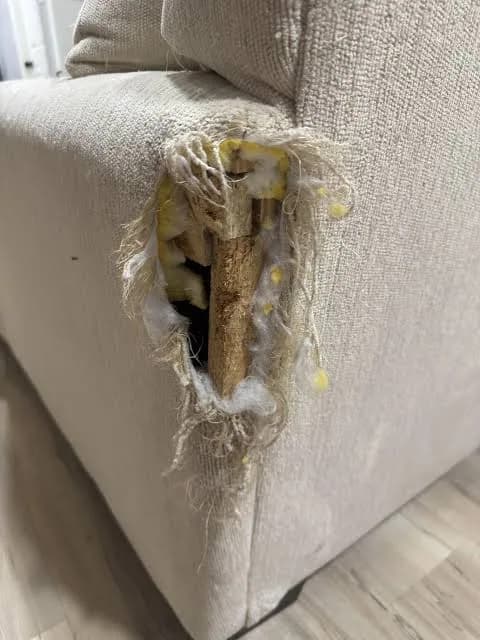
One armrest may be damaged by a pet.
A cushion may have a permanent stain.
One section may have been burned, cut, or torn.
When the rest of the upholstery remains in good condition, replacing every piece of fabric can be unnecessary.
Partial upholstery replacement allows the damaged section to be removed and reconstructed separately.
Typical examples include:
Seat cushions.
Back cushions.
Arm panels.
Front panels.
Side sections.
Dining chair seats.
Ottoman tops.
Individual sectional components.
The main challenge is fabric matching.
Matching Existing Fabric Is Often the Hardest Part
Repairing one section sounds simple until the original fabric is no longer available.
Even when a similar material can be found, differences in color, texture, weave, pattern, or age may remain visible.
Older upholstery may also have faded from sunlight and normal use.
A brand-new piece of the original fabric can sometimes look different from the fabric already on the furniture.
For that reason, partial fabric replacement is easiest when:
The customer has leftover original fabric.
The manufacturer still sells the same material.
A hidden section can provide usable matching fabric.
The furniture design allows the replacement section to look intentionally different.
Sometimes a contrasting fabric is a better solution than trying to create an imperfect match.
One Damaged Cushion Does Not Mean Reupholstering the Whole Couch
Loose cushions are among the easiest furniture components to repair independently.
If one cushion cover is damaged, it may be possible to reproduce only that cover.
The original cushion is used as the pattern.
The new cover can be built with the same general construction, including:
Piping.
Boxed edges.
Zipper placement.
Seam layout.
Top and bottom panels.
Decorative details.
If matching fabric is available, the new cushion can remain visually consistent with the rest of the couch.
If matching fabric is not available, an upholsterer can discuss whether replacing several cushions together would create a cleaner result.
Upholstery Button Repair
Buttons are both decorative and functional.
On tufted furniture, they often help control fabric tension and maintain the shape of the padded surface.
When one button becomes loose or falls off, the surrounding upholstery may begin to look uneven.
A proper button repair is not simply gluing the button back onto the surface.
The button normally needs to be reattached through the upholstery and secured from behind or within the cushion structure.
Depending on the furniture, access may require opening part of the upholstery.
If the original button is missing, a replacement can often be created using matching or similar fabric.
Tufting Repair Requires Correct Tension
Tufted upholstery depends on controlled tension.
If a button loosens, the problem may affect more than one small point.
The surrounding folds can shift.
Padding can move.
The fabric can lose its original pattern.
Repair may involve resetting the button, adjusting the surrounding material, and restoring the original depth of the tuft.
If several buttons have failed, the entire tufted area may need to be adjusted so the result looks balanced.
Stuffing Can Be Repaired Without Changing the Fabric
Furniture can look worn even when the upholstery fabric is perfectly usable.
Back cushions may flatten.
Seat cushions may lose support.
Arms may become uneven.
Decorative cushions may collapse.
In these situations, the problem is inside the furniture rather than on the surface.
The upholstery can often be opened carefully so the internal filling can be adjusted or replaced.
Back Cushion Restuffing
Loose back cushions commonly lose volume over time.
The filling compresses with use and shifts toward the bottom of the cushion.
That can create:
Wrinkles.
Empty corners.
Sagging.
Uneven shape.
Poor back support.
If the original cover is still in good condition, new stuffing can be added without replacing the upholstery.
Depending on the original construction, the cushion may use fiberfill, foam, down, feathers, or a combination of materials.
The goal is not simply to add more filling.
The goal is to restore the original shape and maintain the correct balance between support and softness.
Seat Cushion Foam Replacement
Seat cushions experience much greater compression than back cushions.
When the foam deteriorates, adding loose stuffing is usually not enough.
The cushion may need a new foam core.
Signs can include:
The seat feels much softer than before.
The cushion remains compressed after standing up.
The cover looks loose.
You can feel the furniture base through the cushion.
One side sits lower than the other.
A new foam insert can restore support while allowing the original fabric cover to remain in use.
The density and firmness of the replacement foam can also be adjusted according to the customer's comfort preference.
Piping and Welt Cord Can Be Repaired Separately
The raised trim around cushions and furniture edges is commonly called piping or welt.
Because it sits directly on edges, it can wear before the main upholstery surface.
In some cases, damaged piping can be replaced without replacing the entire upholstered section.
This is especially useful when the center fabric remains in excellent condition but the edge trim has become worn, torn, or exposed.
The feasibility depends on how the original piece was sewn together and whether suitable matching fabric is available.
Localized Tear Repair
Small tears in fabric can sometimes be repaired, but the approach depends heavily on the material.
Unlike leather or vinyl, woven upholstery fabric does not usually allow an invisible surface repair once threads have been cut.
A small tear may sometimes be stabilized or closed.
But if the damaged area is highly visible, replacing the affected panel may produce a cleaner and more durable result.
This is why a photograph alone does not always show whether a fabric repair will be successful.
The condition of the surrounding fibers matters.
Pet Damage Often Requires Section Replacement
Cats and dogs create a specific type of upholstery damage.
Claws may pull individual threads from woven fabric.
Repeated scratching can destroy the weave.
Chewing may remove fabric completely.
If damage is superficial, loose fibers can sometimes be trimmed and stabilized.
If the weave has been significantly compromised, however, the damaged panel usually needs replacement.
On furniture with removable cushions, this can be relatively localized.
On attached arms or backs, more disassembly may be required.
Zippers Can Be Replaced Without Making a New Cushion
A broken zipper does not automatically mean the cushion cover must be replaced.
If the surrounding fabric is still strong, the old zipper can often be removed and a new upholstery zipper installed.
This is common on seat cushions, back cushions, and removable furniture covers.
Replacing the zipper can extend the life of the existing upholstery and make future foam replacement or cleaning easier.
Decorative Details Can Often Be Rebuilt
Furniture upholstery includes many components beyond the main fabric panels.
Repair can also involve:
Decorative nails.
Covered buttons.
Pleats.
Skirting.
Piping.
Welting.
Tufting.
Zippers.
Fabric tabs.
Tie-downs.
Velcro.
Dust covers.
Small failures in these details can make furniture look much older than it actually is.
Repairing them individually can often restore the appearance without a full upholstery project.
The Inside of the Furniture Should Be Checked Too
Visible fabric damage can sometimes be caused by a hidden problem.
A seam may repeatedly open because the cushion is overfilled.
Fabric may stretch because the foam has collapsed.
An attached seat may sag because webbing or springs underneath have weakened.
A button may keep coming loose because the internal anchoring point has failed.
For that reason, upholstery repair should not focus only on what is visible.
A professional inspection considers both the cover and the structure beneath it.
Otherwise, a cosmetic repair may fail again.
When Partial Repair Makes Sense
Partial upholstery repair is usually a good option when most of the existing fabric remains strong and attractive.
It is especially practical when damage is isolated to:
One cushion.
One panel.
One seam.
One armrest.
A small number of buttons.
A zipper.
Internal cushion filling.
Decorative trim.
The more localized the damage, the more likely it is that the original upholstery can be preserved.
When Full Reupholstery Is the Better Choice
There is a point where repairing individual areas stops making sense.
Full reupholstery may be more practical when:
Fabric is worn across many sections.
Multiple seams are failing.
The material has become brittle.
The customer wants a completely different color or style.
Matching fabric is unavailable.
Several cushions and panels need replacement.
The furniture also needs internal rebuilding.
At that stage, continuing to repair isolated areas can cost more over time than rebuilding the upholstery properly.
Upholstery Repair Is About Keeping What Still Works
A good repair does not replace parts unnecessarily.
If the fabric is strong, keep it.
If the cushion cover is good, rebuild the inside.
If only one panel is damaged, replace one panel.
If a seam has opened, repair the seam.
If a button is missing, rebuild the tuft.
If the zipper fails, replace the zipper.
Furniture upholstery repair is often about separating the part that has failed from everything that still has years of useful life remaining.
That is what makes partial upholstery repair valuable.
You do not always need new furniture.
And you do not always need full reupholstery.
Sometimes the right repair is exactly one section.