
Custom Equipment Staging Mats And Salvage Cover Repair By Mail
An equipment staging mat may still have useful life left when one seam opens, a corner tears, or its storage bag gives out. Other projects begin with a different problem: a standard mat has the wrong layout, a cover misses the area it needs to protect, or the folded kit will not fit its compartment.
Lerega evaluates equipment staging mats, SCBA full/empty mats, salvage covers, and storage bags for repair or custom fabrication. Customers across the United States can start a mail-in inquiry with photos and measurements. The item's condition, intended use, and material requirements determine which work is suitable.
For fire departments, rescue teams, and commercial facilities, a useful starting point is deciding whether to repair an existing item, make a replacement from a sample, or develop a different size and layout.
Equipment Mats and Protective Covers Made to Fit
Custom Equipment Staging Mats
Equipment staging mats provide a designated surface for arranging tools and response equipment. Also described as fire equipment staging tarps or rescue tool staging mats, they can use separate sections and markings to organize the equipment assigned to each area.
For a custom mat, specify the finished length and width, the size of each zone, and the wording you need. Include how the mat folds and where it will be stored. A layout that works on the ground also needs to fit the available compartment when packed.
If your department uses a dedicated rapid intervention team (RIT) staging mat, include its required markings and layout. Separate panels, reinforced edges, and storage straps can be discussed during the design review.
SCBA Full and Empty Mats
SCBA full/empty mats separate full breathing-air cylinders from empty ones in a marked staging area. Common layouts use a green FULL section and a red EMPTY section. Ribbed versions include raised separators to help limit cylinder rolling.
For a custom SCBA staging mat or replacement air bottle mat, provide the cylinder dimensions, required capacity, and photographs of the existing arrangement. Include the packed dimensions if the mat needs to fit a particular storage space.
Requested ribbing, separator spacing, and attachment methods need to be evaluated as part of the construction. Your department's existing layout is a useful reference for discussing a replacement.
Custom Salvage Covers
Fire department salvage covers help protect furniture, equipment, and other property from water and loose debris during salvage operations. Their material and seam construction must suit the intended exposure. Custom sizing can accommodate the required coverage, attachment points, and storage space.
Details to include in a request are finished dimensions, reinforced hems or corners, grommet locations, and department or size identification. Show how the cover is draped or secured, and measure attachment positions from clearly identified edges.
When the existing footprint works, a damaged edge or corner may be suitable for a salvage cover repair assessment. If the material has deteriorated throughout, the same item may be more useful as a pattern for a replacement.
Storage Bags for Mats and Cover Sets
A storage bag should fit the kit as your crew actually folds it. Measure the packed length, width, and height, and allow for the way the bag will be loaded into its compartment.
Custom equipment storage bags can be discussed with options such as carrying handles, zipper or flap closures, identification panels, and removable dividers. For an existing bag, the assessment may focus on a failed zipper, worn bottom panel, or damaged handle attachment.
The bag can be evaluated separately when the mats or covers inside it remain in good condition.
When Repair Makes Sense and When to Replace
A repair depends on the strength of the material around the damage and the way the item will be used. Closing a seam is only useful when the surrounding fabric can hold the new stitching.
Our guide to seam and fabric repair explains why failed thread and weakened fabric require different approaches.
| Condition | Possible approach after assessment |
|---|---|
| Open stitching with sound surrounding material | Repair the seam using a method suited to the original construction. |
| One worn edge or torn corner | Rebuild the hem or reinforce the affected area. |
| Pulled grommet or damaged handle attachment | Assess and rebuild the surrounding material before replacing hardware or webbing. |
| Damage limited to one section | Consider panel replacement if the material and joining method allow it. |
| Widespread cracking, peeling, or repeated tearing | Evaluate a replacement made to the required dimensions. |
For a small standard tarp, a new stock item may cost less than repair plus shipping. Custom work becomes more useful when an existing shape, compartment fit, labeling layout, or coordinated set would be difficult to replace off the shelf.
Send an overview and close-up photos through Lerega's commercial repair and custom projects service to discuss the options before shipping.
Making a Replacement from an Existing Sample
An old mat, cover, or bag can provide information that measurements alone may miss: seam positions, corner shapes, reinforcement areas, closure placement, and the way the item folds.
Keep the original intact until the project has been reviewed. Mark the features you want to retain and describe any changes, such as a wider opening, different grommet spacing, or a larger storage bag. Include the desired finished dimensions because a worn sample may have stretched or lost its shape.
For multiple matching pieces, provide the quantity and any differences in unit names or markings. Discuss whether a first sample should be approved before the remaining items are made.
Materials and Construction for the Intended Use
Vinyl-coated fabrics and canvas are used in this product category, but the right material depends on the application. Include the expected exposure, cleaning products, folding requirements, and any material specification your department already uses.
Our guide to PVC and PU-coated fabrics explains why the coating, backing, and intended application matter when comparing materials.
Seam construction matters as well. Some vinyl covers use heat-welded seams to maintain a continuous water barrier. An existing welded construction needs to be reviewed before a sewing repair is proposed.
If your purchase requires documented flame resistance or another tested property, include the exact requirement with the request. Material suitability and the finished construction must be confirmed for that use. A repair should not be assumed to preserve an original certification.
How Mail-In Repair and Custom Sewing Work
- Send photos and project details. Include the whole item, both sides where practical, close-ups of damage, labels, dimensions, quantity, and your shipping ZIP code.
- Review the proposed work. Discuss repair or replacement, material requirements, markings, estimated timing, and shipping arrangements. Confirm whether the original item, a sample, or a measured drawing is needed.
- Ship the approved textile item. Follow the supplied shipping instructions. Items must be clean, completely dry, and free of hazardous residue. Remove equipment and cylinders before packing.
- Confirm the final scope after inspection. If the condition differs from what the photographs showed, any change to the work or estimate is agreed before the project proceeds.
- Receive the completed item. Check dimensions, markings, and fit against the agreed specification, and complete your department's inspection before returning it to service.
A mail-in project lets you send the removable mat, cover, or bag while the vehicle and equipment remain at your facility. Send your required completion date with the initial inquiry so production and shipping time can be considered together.
What Affects the Cost
The estimate depends on dimensions, material, condition, pattern work, reinforcement, hardware, markings, and quantity. A simple seam repair and a new mat with several labeled sections involve different amounts of work.
Include the entire kit in the photos if several pieces need attention. A mat, its storage bag, and a matching cover can then be discussed as one project. Shipping costs and turnaround are confirmed for the specific order.
Facilities managing several repairs can also review the cost and scheduling factors behind commercial repair versus replacement.
Questions About Custom Mats and Cover Repair
Do I need to send the original item?
Start with photos and measurements. A straightforward shape may be assessed from a drawing, while a fitted bag or unusual cover may require the original as a pattern. Lerega confirms what is needed before you ship.
Can I request FULL and EMPTY markings or department identification?
Include the exact wording, colors, placement, and artwork with your inquiry. Available marking methods and their suitability for the selected material are reviewed before the order is accepted.
Can you evaluate only the storage bag?
Yes. Send photographs of the bag, the damaged area, and the packed kit it needs to hold. Zipper repair, panel replacement, or a new bag can be considered independently of the mat or cover.
Are salvage covers the same as fire blankets?
No. Salvage covers are intended for property protection. Equipment staging mats and ordinary protective covers should not be used as fire blankets or personal protective equipment. Any required protective performance needs its own documented specification.
Request a Custom Mat or Cover Quote
Send Lerega photos of your equipment staging mat, SCBA full/empty mat, salvage cover, or storage bag, along with dimensions and the work you need. Include your location, quantity, required date, and material specifications so the project can be assessed for mail-in repair or custom sewing.
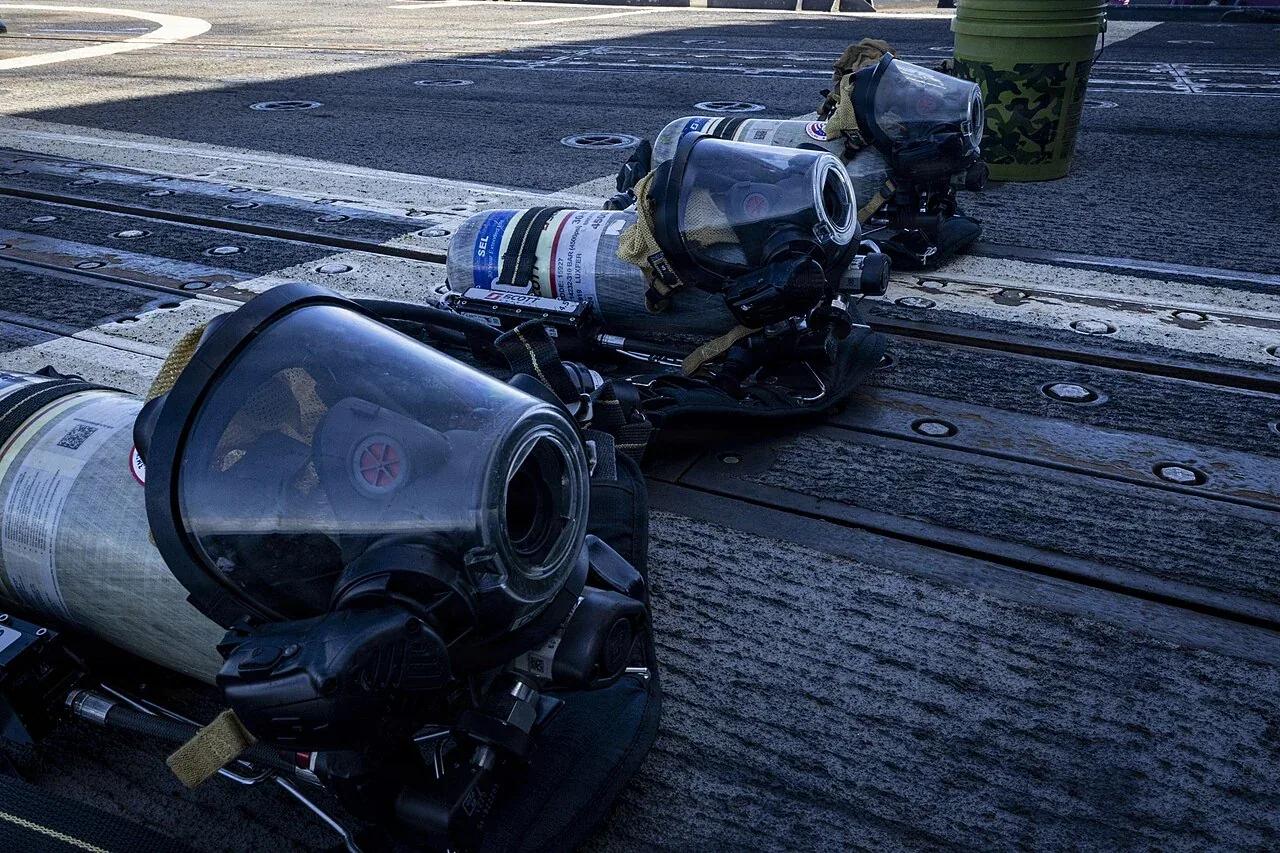
Illustrative photograph: SCBA equipment staged for use. Photo by Cesar Licona / U.S. Navy, via DVIDS. Public domain. The appearance of U.S. Department of War (DoW) visual information does not imply or constitute DoW endorsement.