
Commercial Leather Repair Vs. Replacement Costs
The Hidden Downtime Tax: Why Commercial Leather Repair Beats Replacement
Most businesses evaluate damaged commercial seating by comparing one visible number: the cost of buying new furniture. However, this calculation often overlooks a much larger operational expense—the cost of disruption while replacement furniture is selected, approved, ordered, delivered, and installed.
Commercial leather repair gives facility managers, restaurants, hotels, medical offices, fitness centers, and corporate administrators an opportunity to address damage before it begins affecting operations. Furniture replacement may involve obtaining quotes, securing budget approval, confirming measurements, coordinating freight, scheduling installation, and disposing of the existing pieces.
During this process, torn vinyl, cracked leather, worn armrests, damaged panels, and separated seams remain visible to guests, patients, members, employees, and business partners.
The real question is not only how much a new chair, booth, sofa, headboard, or equipment pad will cost. Businesses must also consider how much disruption they will absorb while waiting for that replacement.
The Downtime Problem Most Businesses Underestimate
Commercial furniture replacement is rarely a simple purchasing decision.
Someone must inspect and measure the existing furniture, verify dimensions, select suitable materials and finishes, compare vendors, request internal approval, and coordinate the order. The business must then wait for inventory, manufacturing, freight delivery, building access, and installation.
The existing furniture must also be removed. Disposal may require additional labor, access to loading areas, coordination with property management, or work outside normal operating hours.
For customer-facing businesses, these delays can create a direct operational cost.
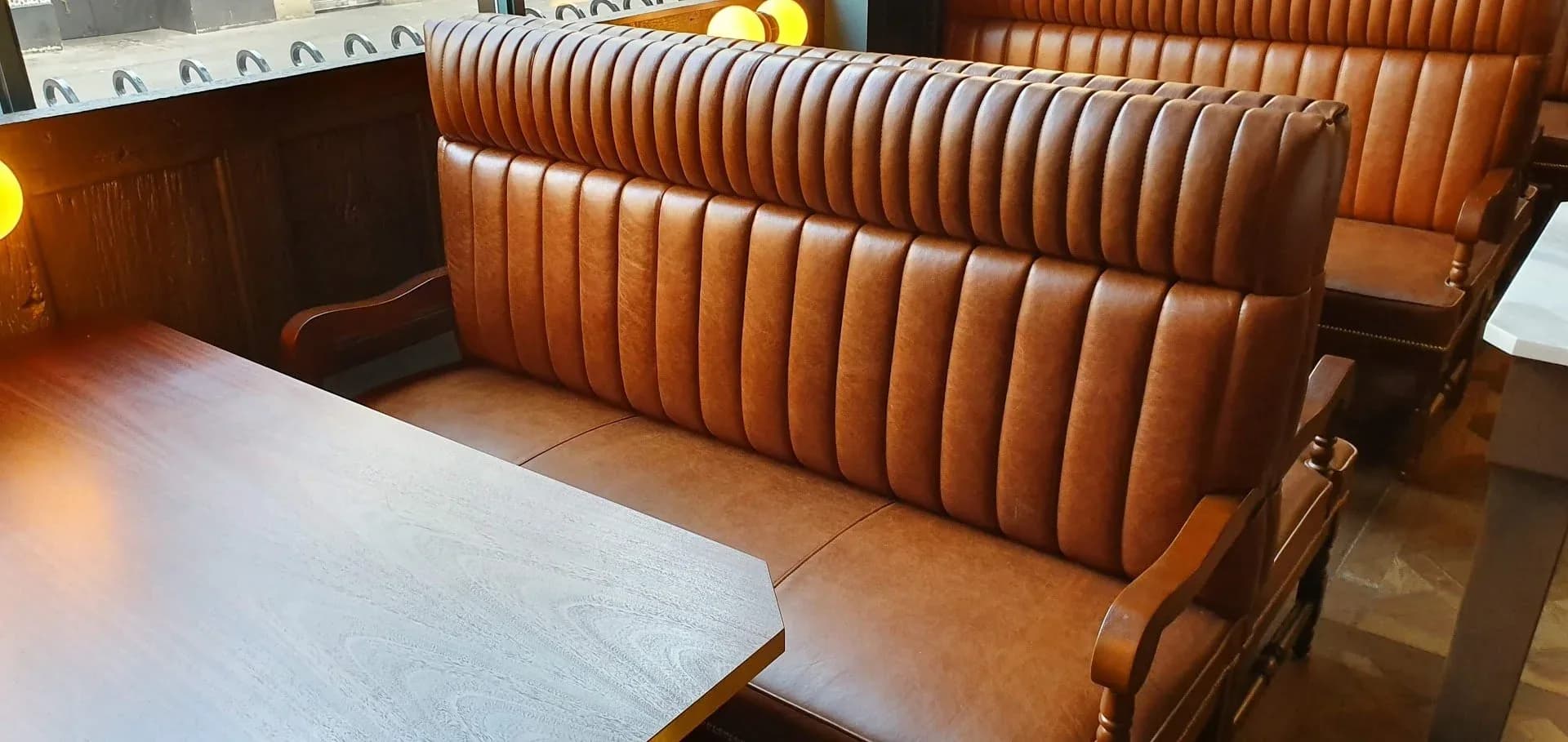
A restaurant may lose several booths during busy service periods. A hotel lobby may appear incomplete or poorly maintained while guests are checking in. A medical office may temporarily reduce its waiting-room capacity. A fitness center may need to remove padded equipment from use. Office furniture replacement may interrupt conference rooms, reception areas, executive offices, or shared workspaces.
The replacement price appears clearly in the budget. The cost of reduced capacity, visible damage, and operational disruption is much easier to overlook.
Why On-Site Repair Protects Revenue and Brand Continuity
On-site commercial leather repair reduces the time between identifying damage and returning the affected furniture to professional use.
Technicians can often repair scratches, fading, surface wear, cracks, torn leather or vinyl, damaged panels, separated seams, restaurant booths, hotel headboards, office chairs, waiting-room furniture, and fitness equipment pads without removing every piece from the facility.
This is important because visible damage does not remain neutral in a commercial environment.
Restaurant guests notice ripped or heavily worn booth seating. Patients may view the condition of waiting-room furniture as part of the facility’s overall cleanliness and professionalism. Hotel guests often interpret worn lobby furniture or damaged headboards as an indication of the property’s overall quality. Employees, visitors, and clients notice deteriorated seating in offices, conference rooms, and reception areas.
Commercial upholstery repair allows many of these problems to be corrected in place and with less interruption. Planned leather and vinyl maintenance can also extend the useful life of commercial furniture by addressing wear before it develops into more extensive structural damage.
In many cases, commercial leather repair is not simply a less expensive alternative. It is a practical way to keep revenue-producing spaces open while maintaining the professional appearance customers expect.
Repair vs. Replacement: The Operational Comparison
| Business Factor | Full Replacement | Professional On-Site Repair |
|---|---|---|
| Upfront Cost | Higher capital expense | Lower repair and maintenance expense |
| Downtime | Extended ordering, delivery, and installation period | Minimal interruption to normal operations |
| Customer Impact | Visible disruption or temporarily unavailable areas | Restored appearance with less inconvenience |
| Flexibility | Requires a larger purchasing and approval decision | Can be scheduled by item, room, section, location, or priority |
The strongest commercial maintenance programs treat commercial upholstery repair as part of planned facility management rather than waiting for damage to become an emergency.
Contract upholstery services allow facility managers to organize work by room, floor, department, furniture type, severity, or operational priority. Repairs can be scheduled in stages instead of requiring the business to replace an entire furniture package at once.
This approach is particularly effective for restaurant groups, hotels, medical facilities, corporate campuses, fitness centers, and other multi-location businesses that need consistent results while controlling budgets and minimizing downtime.
Conclusion
Commercial furniture damage should not be treated only as a cosmetic problem when it affects customer perception, usable capacity, operating schedules, and replacement budgets.
Replacement remains necessary when frames have failed, layouts are changing, or the upholstery materials have deteriorated beyond reliable repair. However, many common leather and vinyl problems can be professionally evaluated before a business commits to a larger capital purchase.
A professional assessment helps decision-makers understand which items can be repaired, which components should be replaced, and how the work can be scheduled with the least possible disruption to business operations.