
Leather Repair Certification: What It Means
A leather repair certificate can look impressive on a wall.
But the piece of paper is not what makes someone a professional. The real question is what happened before that certificate was issued and what skills the student can demonstrate after completing a leather repair course.
Did the student learn how to identify different types of leather?
Can they diagnose damage correctly?
Can they determine when leather should be repaired and when it should be replaced?
Can they match color accurately?
Can they repair a tear without creating an obvious patch?
Can they prepare, recolor, finish, and protect leather so the repair withstands actual use?
Can they inspect a customer’s item, estimate the work, explain the limitations, and stand behind the result?
That is what leather repair certification should represent.
A meaningful certificate should indicate that the student has completed structured technical training and demonstrated practical skills—not simply attended a class. The value of a leather restoration course therefore depends on the depth of its curriculum, the amount of hands-on practice, the range of materials and repair techniques covered, and the standard students are expected to meet before receiving their certificate.
Unfortunately, a certificate and professional competence are not always the same thing.
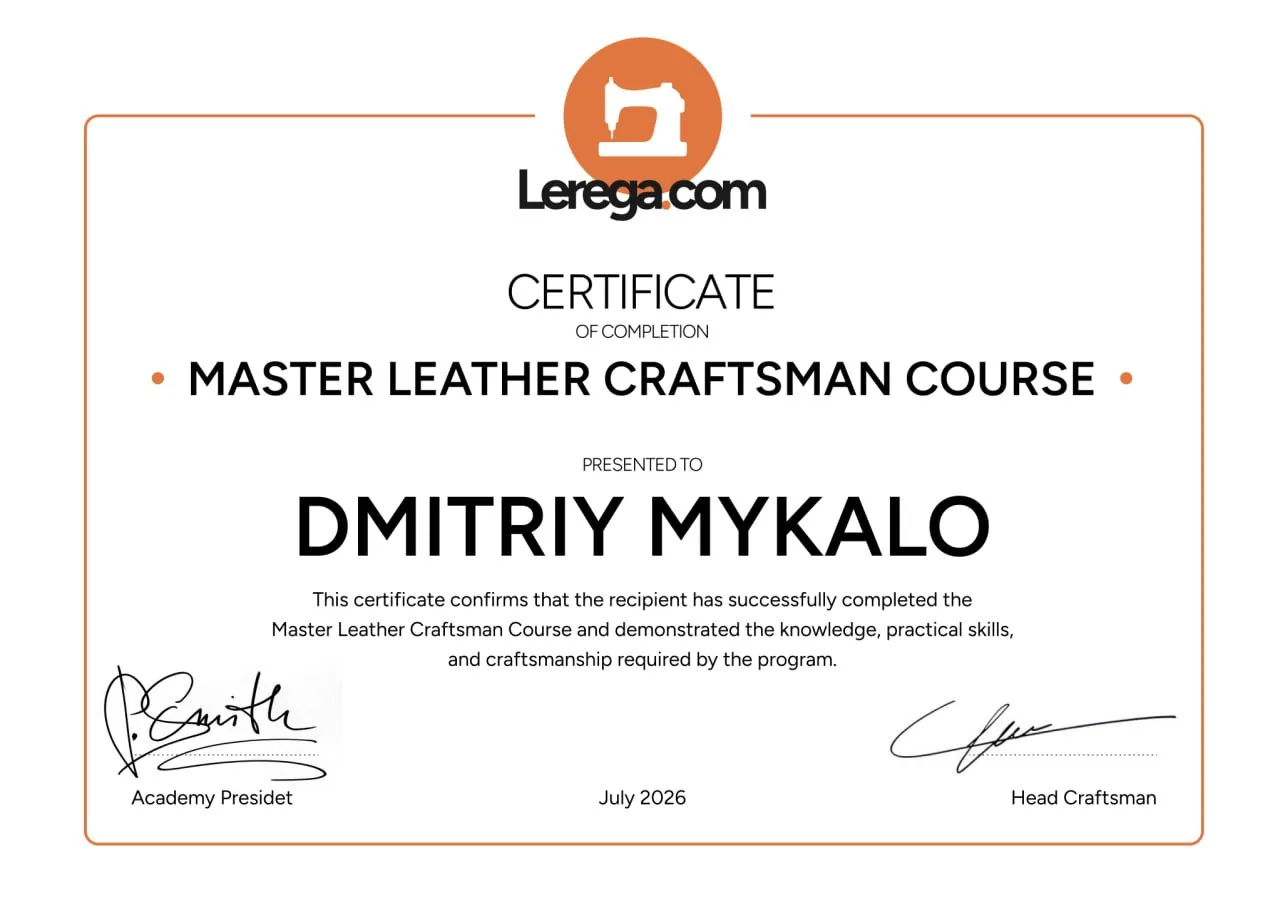
What Is Leather Repair Certification?
Leather repair certification is evidence that a student has completed a defined restoration program and, depending on the level of certification, demonstrated the knowledge and practical ability required by the training organization.
There is an important distinction.
A certificate of completion confirms that someone completed a course.
Professional certification should go further.
It should indicate that the technician has been trained in professional procedures and has demonstrated the skills required to perform restoration work to an established standard.
At Lerega Academy, completing the core leather repair course provides a certificate of completion. Professional certification under Lerega standards requires advanced hands-on training, practical skill evaluation, and qualification.
That distinction matters.
We do not believe someone should become a "professional leather technician" simply because they watched a series of videos.
A Certificate Is Only as Credible as the Organization Behind It
Before choosing a leather repair certification program, investigate the organization issuing the certificate.
Do not look only at the course page.
Look at the actual business behind it.
Does the company currently repair leather for paying customers?
Can you see real restoration projects?
Does it have a functioning service website?
Can customers actually request an estimate?
Are there examples of furniture, automotive, handbag, marine, RV, or commercial restoration?
Does the company have technicians performing this work today?
Does it publish real before-and-after results?
Can you see evidence that its methods are being used outside a classroom?
These questions are important because leather restoration is a trade.
It is learned from solving real problems on real objects.
Learn From People Who Actually Do the Work
There is a significant difference between teaching information and practicing a profession.
A person can purchase a restoration system, learn its basic instructions, reproduce those instructions in a course, and begin selling training.
That does not necessarily mean that person has spent years diagnosing difficult client projects.
It does not mean they know what happens when a repair fails.
It does not mean they have dealt with contaminated leather, previous coatings, unusual finishes, badly chosen repair materials, difficult color matches, aged leather, structural deterioration, or customers with unrealistic expectations.
And it does not mean they know how to operate a successful restoration service.
Before paying for training, ask a simple question:
Where is the instructor's actual restoration business?
If you cannot find it, that deserves further investigation.
Why Lerega Academy Is Different
Lerega Academy was built from a working leather and upholstery restoration business.
The training did not come first.
The restoration work did.
The techniques taught in the program are based on the same processes used for real customer projects involving furniture, handbags, automotive interiors, RVs, marine interiors, commercial upholstery, and other leather goods.
Lerega's restoration operation reports more than 11 years of professional experience and more than 5,200 leather items restored.
Students can see actual project examples, real damage, real repair decisions, and the results produced for customers.
That is important because our instructors are not teaching a profession they left years ago.
We are still working in it.
Why Real Client Experience Matters
Training material usually shows a controlled repair.
Professional work is rarely controlled.
A customer may send you a couch that has already been unsuccessfully repaired.
A car seat may contain several materials that look similar but require different methods.
An old piece of leather may appear repairable in a photograph but prove structurally deteriorated during inspection.
A handbag may require a completely different finishing system from furniture.
A previous technician may have applied products that interfere with adhesion.
Body oils may have penetrated deeply enough that recoloring without proper treatment will eventually fail.
Professional experience teaches something that a manual cannot teach by itself:
how to make decisions.
Leather restoration is not simply following steps.
It is knowing which steps belong to this particular job.
We Have Seen Students Who Had to Learn Twice
Some people come to professional training after already completing another leather repair course.
They have a certificate.
They may have purchased tools and materials.
They may even have attempted customer work.
But when their practical knowledge is evaluated, important fundamentals are sometimes missing.
They may not understand leather identification.
Their surface preparation may be incomplete.
They may know how to spray color but not how to match it properly.
They may know how to fill damage but not how to determine whether the substrate is stable enough to repair.
They may have learned one manufacturer's process without understanding why each step is performed.
In these cases, the student is effectively paying for education twice.
First for a certificate.
Then again to learn the profession.
That is why the price of a course should never be the only criterion when choosing leather repair training.
Poor training can become much more expensive than professional training.
A Professional Must Understand More Than Repair Techniques
Leather restoration training should not stop at scratches and tears.
A technician needs a complete system of knowledge.
Leather Identification
Different leathers react differently to cleaners, pigments, dyes, fillers, heat, moisture, and finishing products.
If the technician misidentifies the material, every decision afterward may be wrong.
Professional Diagnostics
Before repairing anything, the technician must determine what caused the damage and whether the underlying material remains suitable for restoration.
Surface Preparation
A repair can look perfect when it leaves the workshop and begin failing weeks later because the surface was not properly cleaned, degreased, prepared, or stabilized.
Damage Repair
Cuts, punctures, cracks, scratches, worn grain, missing material, stitching damage, and structural problems require different techniques.
Color Matching
Buying "brown leather paint" is not professional color restoration.
The technician must understand hue, value, saturation, undertones, opacity, application, sheen, and how surrounding aged leather affects the perceived match.
Finishing
A professional repair requires the correct protective coating and finish system, not simply pigment.
Job Evaluation
A technician must know when a repair should not be performed.
Sometimes replacement, panel replacement, or reupholstery is the correct recommendation.
Pricing and Client Communication
Knowing how to repair something does not automatically mean knowing how to operate a repair business.
Students need to understand estimating, labor, materials, risk, customer expectations, workflow, and quality control.
These areas are all incorporated into the Lerega training path.
What Does an International Leather Repair Certificate Mean?
Lerega Academy provides an international certification path for students who want to build professional leather restoration skills regardless of the country or region in which they plan to work.
"International" should not be confused with a government occupational license.
Leather repair requirements vary by jurisdiction, and a private professional certificate should never be presented as a government-issued license unless it actually is one.
The value of an international professional certificate is different.
It identifies the training organization, the professional standard under which the technician was trained, and the skills or qualification level the student successfully completed.
For Lerega, certification is connected to our restoration standards rather than simply course attendance.
The purpose is for the certificate to represent demonstrated professional preparation.
Certificate of Completion vs. Professional Certification
This distinction is important when comparing courses.
Certificate of Completion
This confirms that a student completed the core educational program.
It shows that the student has studied the fundamental theory, materials, diagnostic methods, repair processes, color restoration, finishing, estimating, and professional workflow included in the course.
Professional Lerega Certification
Professional certification requires additional practical development.
Students continue into advanced hands-on training, work on practical restoration techniques under supervision, and undergo skill evaluation before qualification.
Certification therefore represents a higher standard than simply completing online lessons.
Why Hands-On Evaluation Matters
You can understand color theory and still struggle to match a real color.
You can understand how a tear repair works and still make the repair too stiff.
You can understand how an airbrush operates and still apply too much material.
You can understand grain restoration and still create a texture that becomes visible from across the room.
There is a difference between knowing what to do and being able to do it consistently.
Hands-on evaluation exposes that difference.
An instructor can see how a student holds a tool, prepares an area, builds a repair, mixes color, applies coatings, controls texture, and evaluates the final result.
That feedback is extremely difficult to replace.
Do Not Choose Training Based on the Certificate Design
A gold seal does not make a certification valuable.
Neither does an impressive title.
Before enrolling, investigate what the certification actually requires.
Ask:
Does the training company operate a real leather repair business?
Look for current service pages, customer projects, before-and-after examples, and actual restoration activity.
Who teaches the course?
Determine whether the instructors currently perform professional restoration or primarily sell education.
Is practical work required?
A serious professional qualification should involve demonstration of practical skill.
Is there an evaluation?
Find out whether every paying student receives certification automatically or whether professional qualification must actually be earned.
Does the program teach diagnostics?
Knowing how to perform one technique is not enough. Professionals need to know when that technique should and should not be used.
Does it teach color matching?
Professional color restoration is one of the fundamental skills of the trade.
Does it teach business workflow?
If your goal is to make money from the profession, estimating, customer communication, pricing, job evaluation, and service workflow matter.
Can you see the provider's own work?
This may be the simplest test of all.
If someone is teaching professional restoration, you should be able to see evidence that they can professionally restore leather.
Training Should Prepare You for the Customer, Not Just the Exam
Passing an exam is useful.
But customers do not bring you exams.
They bring you damaged couches.
Car seats.
Designer handbags.
Restaurant booths.
RV interiors.
Marine seating.
Old leather.
New leather.
Previous repairs.
Unknown coatings.
Oil contamination.
Color loss.
Tears.
Cracks.
And occasionally projects that should never be repaired at all.
Professional training should prepare you to stand in front of one of those projects and make the correct decision.
That is the standard that matters after the course is finished.
Certification Can Also Affect Your Business Credibility
When you begin working professionally, customers have to decide whether they trust you with their property.
A recognized training background can help demonstrate that you have invested in professional education rather than simply experimenting with repair products.
Certification can be particularly useful when introducing yourself to:
Furniture stores.
Interior designers.
Automotive businesses.
Dealerships.
Property managers.
Hotels.
Restaurants.
Marine businesses.
RV companies.
Commercial clients.
Other restoration professionals.
But certification works best when it is supported by actual ability, a portfolio, customer reviews, professional communication, and consistent results.
The certificate opens a conversation.
Your work proves it.
From Certification to Professional Partnership
For some technicians, training is only the beginning.
Qualified Lerega students and experienced professionals can also apply for evaluation as regional Lerega partners.
Partner approval is not automatic.
It requires appropriate skills, quality standards, professional readiness, and evaluation.
This creates another distinction between simply purchasing education and qualifying to perform work associated with an established restoration brand.
The goal is not to produce as many certificates as possible.
The goal is to develop technicians whose work can meet a professional standard.
The Cheapest Course Can Become the Most Expensive Course
Imagine two training programs.
The first costs less and gives you a certificate quickly.
You finish feeling confident, purchase materials, advertise your services, and begin accepting projects.
Then difficult jobs arrive.
Color matching does not work as expected.
Repairs begin failing.
You cannot identify why coatings are not adhering.
You do not know which projects should be declined.
Eventually, you stop accepting jobs and look for another training program.
Now you pay again.
The second course may have cost more initially, but if it gave you a real professional foundation, it was ultimately the less expensive education.
When selecting vocational training, measure cost against competence rather than the number printed on the checkout page.
Before You Choose a Leather Repair School, Look Behind the Course
Do not begin with:
How quickly can I get certified?
Begin with:
Who will be teaching me?
What do they repair?
Where can I see their work?
How long have they actually performed this service?
Do they still work with customers?
What happens when a repair is complicated?
Will anyone evaluate my work?
What exactly must I demonstrate before I can call myself certified?
Can this training prepare me to accept a real customer's property with confidence?
Those questions tell you much more about the value of a program than the certificate itself.
A Certificate Should Represent a Skill
Professional certification should be difficult enough to mean something.
At Lerega Academy, we believe training should create professionals, not simply course graduates.
Our education is built around the same real-world restoration work our business performs for customers.
The core program develops the foundation.
Hands-on training develops practical ability.
Evaluation demonstrates whether that ability meets the required standard.
Certification documents that achievement.
If your goal is simply to collect another certificate, there are many courses available.
If your goal is to learn leather restoration well enough to work professionally, choose the place where the profession is actually practiced.
Explore Professional Leather Repair Training
Learn from working professionals.
Build the skill.
Prove the skill.
Then let the certificate represent something real.